Who Actually Owns a Tokenized Asset?

Mantasha Tarannum
Tokenization
12
min read

The real-world asset (RWA) tokenization market is moving from experimentation toward financial infrastructure.
According to CoinGecko's 2026 RWA report, tokenized RWAs excluding stablecoins grew from $5.42 billion at the beginning of 2025 to $19.32 billion by March 31, 2026 with a 256.7% increase.
Tokenized Treasuries reached approximately $12.99 billion, while tokenized commodities reached $5.55 billion. Gold-backed tokens were a major driver of commodity growth.
The numbers are significant.
But market size is only part of the story.
As more real estate, commodities, securities, funds and other assets move onto blockchain-based systems, one fundamental question becomes increasingly important:
Who actually owns a tokenized asset?
The answer is not always as straightforward as looking at the wallet holding the token.
Token Ownership and Asset Ownership Are Not Always the Same
The basic idea behind tokenization sounds simple.
A real-world asset is represented digitally.
A token is created.
An investor purchases that token.
The blockchain records the transaction.
But there is a critical distinction between owning the token and owning the underlying asset or legal rights associated with it.
Consider a ₹100 crore commercial property.
A platform could create 10 million tokens connected to the property.
An investor purchases 100,000 tokens.
It may be tempting to conclude that the investor owns 1% of the building.
But that conclusion depends entirely on the legal and financial structure.
The token could represent:
direct ownership of the property;
shares in an entity that owns the property;
a beneficial interest;
units in an investment fund;
rights to a portion of rental income;
a debt claim;
or synthetic exposure to the property's value.
The blockchain may look similar in each case.

The legal relationship can be completely different.
What Is Actually Being Tokenized?
One of the most useful ways to understand RWA tokenization is to stop thinking about the token as the asset itself.
Instead, think about claims and rights.
The Bank for International Settlements describes tokenization as transforming claims on real or financial assets into tokens on programmable platforms. It identifies three central components: assets, ledgers and tokens.
That distinction matters.
A building does not become a blockchain object simply because a token references it. Instead, a legal and economic relationship is created between:
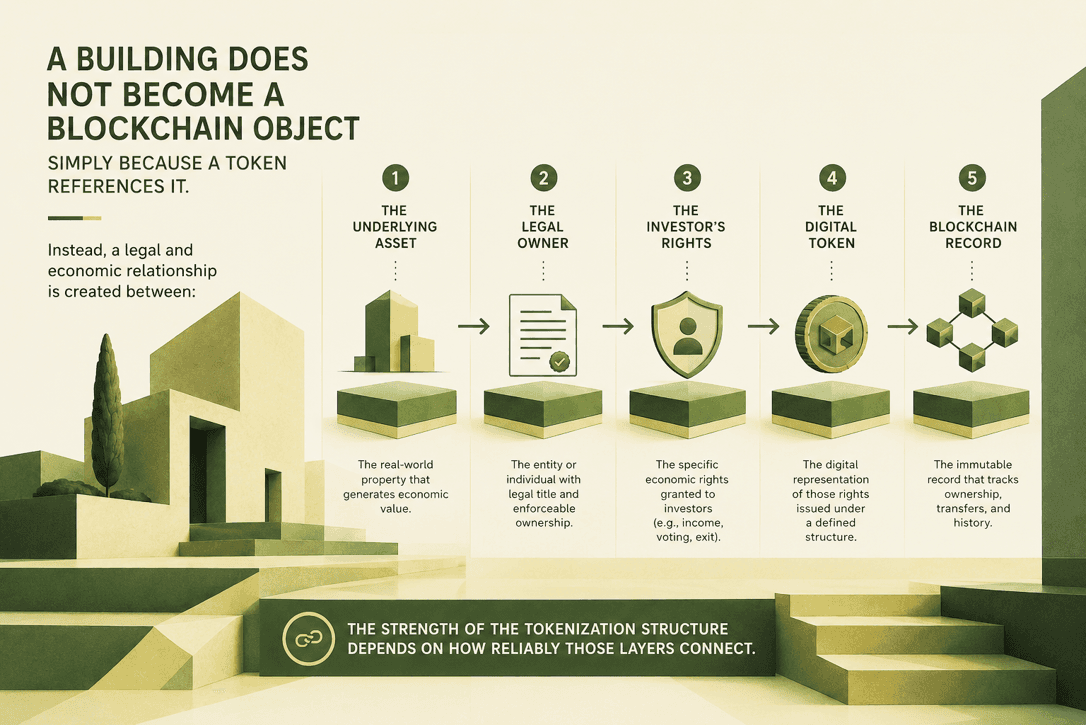
The strength of the tokenization structure depends on how reliably those layers connect.
The Five Layers of Tokenized Ownership
1. The Underlying Asset
Everything begins with the asset.
It could be:
Real estate.
Gold.
Private credit.
A fund.
Infrastructure.
A commodity.
A vehicle.
Before discussing blockchain, the first question should be:
Who legally owns the asset?
For real estate, that may involve a registered property owner.
For gold, it could involve a custodian or reserve structure.
For securities, it may involve an issuer, broker, custodian or transfer agent.
The legal ownership structure exists before the token.
Tokenization must connect to it.
2. The Legal Vehicle
The underlying asset may be held directly by the investor.
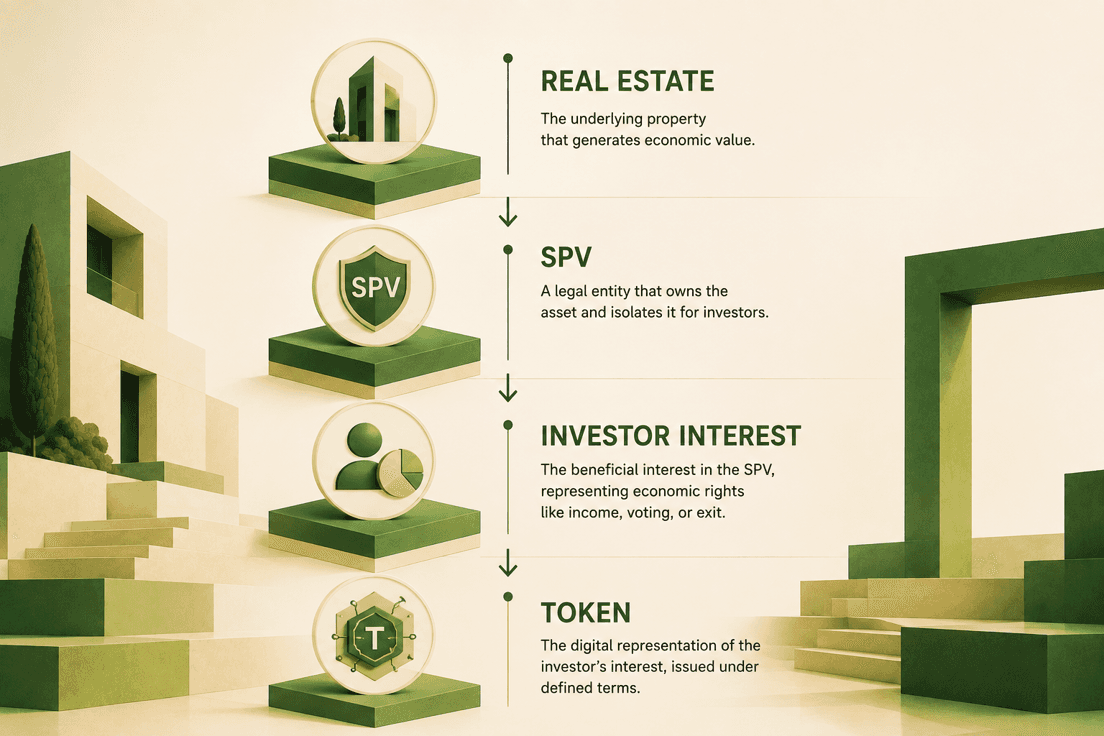
But in many investment structures, the asset sits inside a legal entity such as an SPV, trust or fund.
For example:
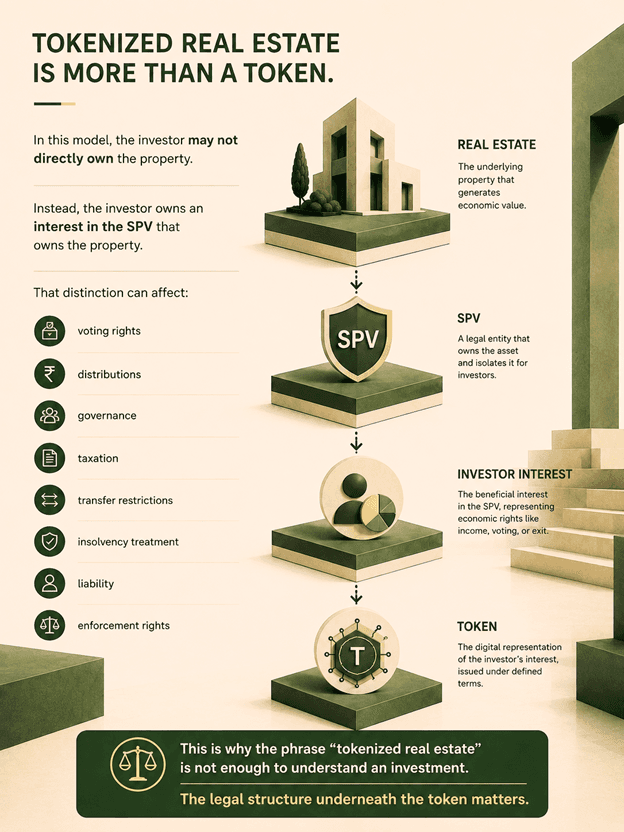
In this model, the investor may not directly own the property.
Instead, the investor owns an interest in the SPV that owns the property.
That distinction can affect:
voting rights;
distributions;
governance;
taxation;
transfer restrictions;
insolvency treatment;
liability;
and enforcement rights.
This is why the phrase “tokenized real estate” is not enough to understand an investment.
The legal structure underneath the token matters.
3. The Investor's Rights
The next question is:
What rights does the investor actually receive?
A token may provide:
ownership rights;
economic rights;
income rights;
voting rights;
redemption rights;
repayment rights;
governance rights;
or a combination of these.
The important point is that the token's economic description and its legal rights should not be assumed to be identical.

The U.S. Securities and Exchange Commission's January 2026 statement on tokenized securities illustrates this distinction.
The SEC describes different tokenization models, including structures where tokens represent ownership interests or security entitlements and structures where tokens instead provide synthetic exposure to an underlying security. The rights attached to the token depend on the structure.
Therefore:
A token's name does not determine an investor's rights. The underlying legal and financial arrangement does.
4. The Token
Only after the legal and economic structure is established does the blockchain layer come into focus.
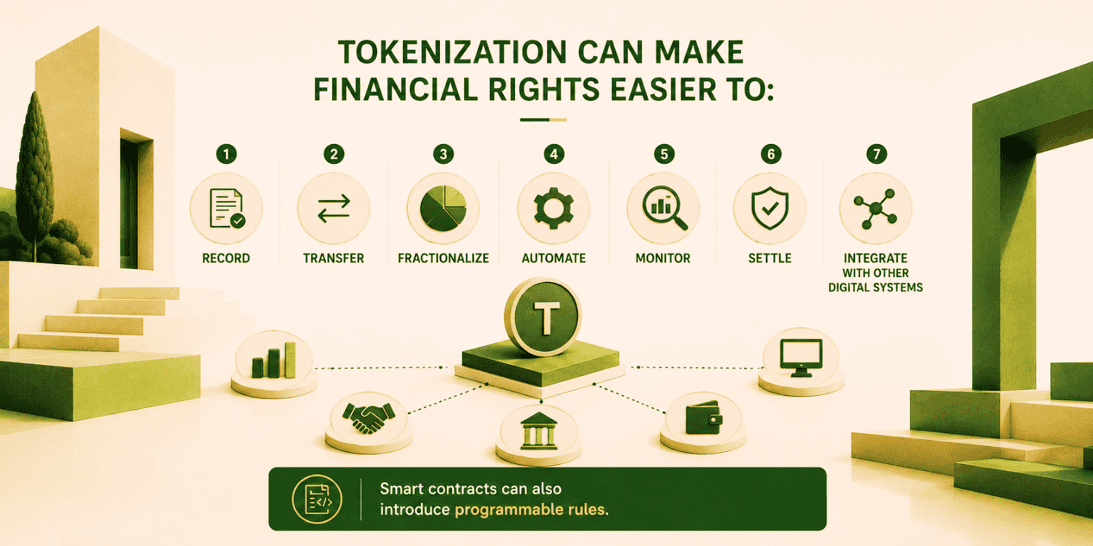
Tokenization can make financial rights easier to:
record;
transfer;
fractionalize;
automate;
monitor;
settle;
and integrate with other digital systems.
Smart contracts can also introduce programmable rules.
For example, a token transfer could automatically check whether an investor satisfies certain eligibility requirements before allowing a transaction.
This is one of the major potential advantages of tokenization.
But it also creates an important limitation.
Blockchain can automate rules.
It cannot automatically create the legal rights those rules are supposed to represent.
The SEC has similarly emphasized that tokenization does not by itself change the underlying nature of a security.
5. The Authoritative Ownership Record
Perhaps the least visible and one of the most important questions is:
Which record determines ownership?
Is it:
The blockchain?
A government registry?
A transfer agent?
A custodian?
An SPV shareholder register?
A fund administrator?
Or several systems working together?
This becomes particularly important for assets such as real estate, where legal ownership may continue to depend on established registries and documentation.
The BIS has noted that tokenization faces technical and legal challenges when traditional ownership systems and blockchain-based systems must interact. For property, for example, existing titles can remain in local registries, creating an “off-chain” component that must be connected to the tokenized system.
This creates a practical trade-off.
A blockchain may make transfers faster and more transparent.
But if the underlying legal record still sits somewhere else, the two systems need to remain synchronized.
The “Digital Twin” Problem
This is sometimes described as the digital twin model.
The token represents an asset or claim digitally.
But the primary legal ownership record remains outside the blockchain.
The token and the traditional record therefore need to remain aligned.
This model has an important advantage:
It can build on existing legal and financial infrastructure.
But it also has a limitation:
It does not completely eliminate reconciliation.
The Bank for International Settlements noted in 2026 that many tokenized assets currently operate through this type of digital-twin structure. It can deliver efficiency gains, but synchronization with the off-chain ownership record remains necessary.
This illustrates one of the central trade-offs in RWA tokenization:
Innovation versus legal continuity.
Moving everything on-chain may create greater automation.
Keeping existing systems involved may provide greater legal familiarity.
The optimal structure depends on the asset, jurisdiction and regulatory environment.
Three Common Ownership Structures
Not every tokenized asset follows the same model.
Three broad structures help illustrate the differences.
Direct Tokenized Ownership
In the first model, the token itself represents a legally recognized ownership interest in the underlying asset.
The relationship can look like:
Asset to Token Holder
This can provide a relatively direct connection between the investor and the asset.
However, direct ownership can be difficult to implement for assets whose legal title is governed by physical registries, transfer restrictions or jurisdiction-specific property laws.
SPV or Fund Structure
A second approach uses a legal entity.
The structure becomes:
Asset to SPV/Fund to Investor Interest to Token
This can provide a clearer framework for pooling assets, managing governance and separating the asset from the operating platform.
But it introduces another layer between the investor and the underlying asset.
The investor must therefore understand the rights attached to the entity interest—not simply the token.
Synthetic Exposure
A third structure gives investors economic exposure to an asset without giving them direct ownership of it.
The structure could look like:
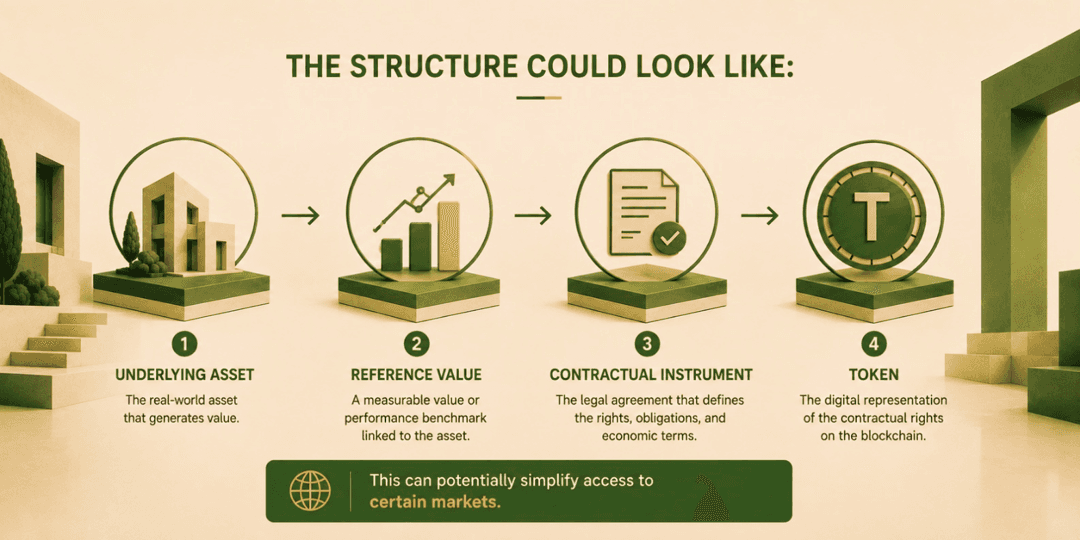
This can potentially simplify access to certain markets.
But it creates additional counterparty considerations.
The investor's claim may be against the issuer or another intermediary rather than directly against the underlying asset.
The SEC has highlighted this distinction in its discussion of tokenized securities and synthetic exposure.
The Trade-Off: Accessibility vs. Protection
One of tokenization's major promises is accessibility.
Fractionalization can lower the minimum investment required to access certain assets.
A property that previously required millions of dollars of capital could potentially be divided into smaller digital interests.
But accessibility introduces another question:
Who is allowed to participate?
Not every tokenized asset should necessarily be available to every investor.
Depending on the structure and jurisdiction, securities laws, investor eligibility requirements, KYC/AML obligations, transfer restrictions and other regulatory requirements may apply.
The BIS has emphasized that tokenization must address investor protection, cybersecurity, regulatory compliance and cross-border coordination.
Therefore, greater accessibility does not necessarily mean unrestricted access.
A well-designed platform must balance both.
The Trade-Off: Liquidity vs. Market Reality
Tokenization is frequently marketed as a way to make illiquid assets liquid.
That proposition needs some qualification.
Creating a token does not automatically create buyers.
A tokenized property can be technically transferable while still having limited secondary-market demand.
Liquidity depends on:
investor demand;
market depth;
asset quality;
pricing transparency;
transfer rules;
regulatory permissions;
market infrastructure;
and confidence in the underlying asset.
Recent BIS research on tokenized real estate found that tokenization can address certain liquidity gaps, but the benefits depend on institutional features such as market design and buyback mechanisms. Such mechanisms can themselves create additional solvency risks.
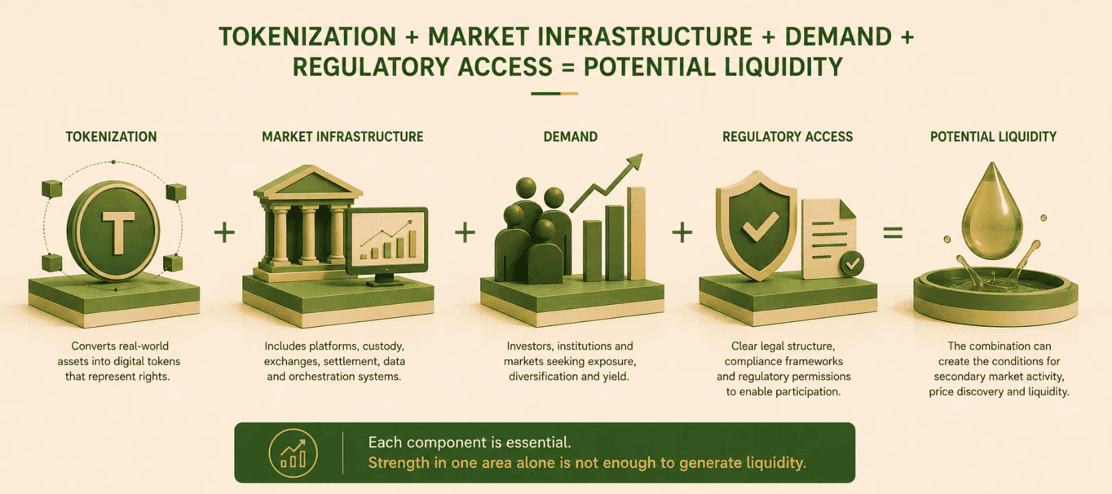
So the equation is not:
Tokenization = Liquidity
It is closer to:
Tokenization + Market Infrastructure + Demand + Regulatory Access = Potential Liquidity
The Trade-Off: Automation vs. Complexity
Smart contracts can automate processes.
For example:
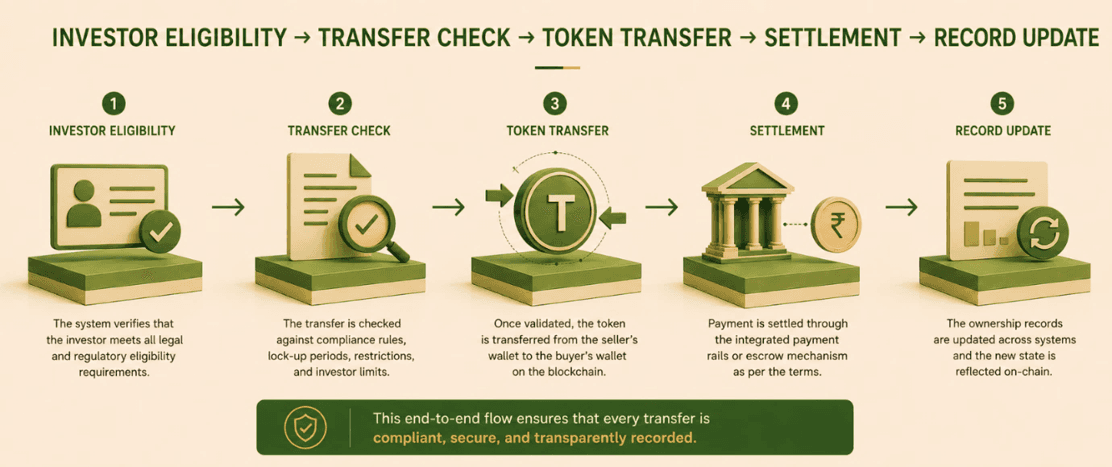
This can reduce manual reconciliation and operational friction.
The BIS has identified programmability and automated transaction execution as important potential benefits of tokenization.
But automation introduces its own risks.
What happens if:
the smart contract contains an error?
the legal agreement changes?
the underlying asset is sold?
an investor loses access to a wallet?
a regulator changes the rules?
the off-chain ownership record is updated?
the asset becomes subject to a dispute?
A smart contract can execute code.
It cannot independently resolve every legal or commercial dispute.
That is why sophisticated tokenization systems need legal governance alongside technical governance.
The Trade-Off: Transparency vs. Privacy
Blockchain can create highly transparent transaction records.
This can improve auditability.
But financial ownership also involves sensitive information.
Investor identities, transaction histories and financial positions may require privacy protections.
This creates another balancing act:
Transparency for compliance and auditability
versus
Privacy for investors and institutions
The solution is unlikely to be complete transparency or complete anonymity.
Instead, institutional systems generally need controlled access, identity verification and appropriate data governance.
The Role of Custody
Custody becomes especially important when a digital token represents an asset held somewhere else.
Imagine a gold-backed token.
The token may trade digitally.
But the gold still needs to exist.
Someone needs to:
hold it;
verify it;
reconcile quantities;
manage access;
protect it;
and establish what happens if the issuer or custodian fails.
The same principle applies to real estate and other physical assets.
Digital representation does not remove physical custody.
It creates a connection between digital rights and physical or traditional assets.
That connection must be continuously maintained.
What Happens When Things Go Wrong?
This may be the best test of any tokenization model.
Imagine the issuer becomes insolvent.
The important questions are no longer about blockchain speed.
They become legal questions.
Who owns the underlying asset?
Can investors make a claim against it?
Are they secured or unsecured?
Does the SPV ring-fence the asset?
What happens to the token?
Who controls the custody arrangement?
Which legal document governs the investor's rights?
These questions demonstrate why tokenization should not be evaluated solely as a technology project.
It is simultaneously a:
Legal project.
Financial project.
Compliance project.
Custody project.
Technology project.
Why Regulatory Classification Matters
The regulatory treatment of a token depends heavily on what it represents.
A token representing a security may be regulated as a security.
A token representing a commodity interest may fall under a different framework.
A token representing an investment fund may have another set of requirements.
A token representing direct property rights can raise entirely different legal questions.
The technology does not determine the regulatory classification by itself.
The underlying rights, structure and economic substance matter.
This is reflected in the SEC's 2026 tokenized-securities guidance, which distinguishes tokenization structures according to the rights and relationships created by them.
For businesses building RWA platforms, this makes regulatory classification a design question—not an afterthought.
What Should Investors Ask Before Buying a Tokenized Asset?
A useful due-diligence framework can be reduced to ten questions.
1. What exactly does the token represent?
Do not rely solely on marketing terminology.
Read the legal definition.
2. Who owns the underlying asset?
Identify the actual legal owner.
3. Is there an SPV, trust, fund or custodian?
Understand the ownership chain.
4. What rights does the investor receive?
Ownership, income, voting, redemption or contractual exposure?
5. Where are those rights documented?
Look beyond the smart contract.
6. Which record determines ownership?
Blockchain, registry, transfer agent or another authoritative system?
7. Who controls the underlying asset?
Understand custody and governance.
8. Who can buy and transfer the token?
Check eligibility and transfer restrictions.
9. What happens if the issuer fails?
Understand insolvency and recovery rights.
10. Is there actually a secondary market?
Transferability is not the same as liquidity.
What This Means for Real Estate Tokenization
Real estate is one of the most interesting—and challenging—applications of RWA tokenization.
Property is inherently physical.
Ownership is often jurisdiction-specific.
Titles and registrations may exist in government systems.
Transactions can involve lawyers, banks, brokers, custodians, registrars and other intermediaries.
Tokenization can potentially improve parts of this process.
It can enable:
Fractionalization
Digital investor onboarding
Programmable transfers
Automated distributions
Transparent ownership records
Faster settlement
But the fundamental property rights still need to be established.
This is why real estate tokenization should be viewed as an integration problem between property law, financial structuring and digital infrastructure.
The strongest model is not necessarily the one that puts the most information on-chain.
It is the one that creates the clearest connection between:
Property
→ Legal ownership
→ Investor rights
→ Custody
→ Token
→ Transfer
→ Settlement
→ Reporting
The Bigger Picture: Tokenization Is More Than Fractionalization
Fractional ownership gets most of the attention.
But the longer-term opportunity may be broader.
Tokenization can potentially integrate:
Ownership
Identity
Compliance
Transfer restrictions
Settlement
Payments
Corporate actions
Reporting
into programmable workflows.
The BIS has argued that tokenization can combine information about an asset with rules governing its transfer, potentially allowing transactions that are currently separated across multiple systems to become more integrated.
This could eventually change how financial markets operate.
But it will not happen simply because assets are placed on blockchain.
It requires legal recognition, interoperable systems, reliable custody and credible governance.
The Future Question Is Not “Can We Tokenize It?”
The technology can tokenize many things.
The harder question is:
Should this asset be tokenized, and what structure best preserves its economic and legal integrity?
This is where the trade-offs become important.
An asset with standardized ownership records may be easier to tokenize than one governed by fragmented property registries.
An asset with deep investor demand may benefit more from fractionalization than one with limited market interest.
A highly regulated security may require more compliance infrastructure than a simpler asset.
A physical commodity may require stronger custody and reserve verification.
The BIS describes this as a “tokenisation continuum”: the easiest assets to tokenize may not necessarily deliver the largest benefits, while more difficult assets may offer greater potential gains if their legal, economic and technical challenges can be addressed.
Conclusion: The Token Is Only One Piece of Ownership
The RWA market is growing quickly.
But the industry's long-term credibility will depend on something more fundamental than market capitalization.
It will depend on whether investors can clearly answer:
What do I actually own?
A token can represent an asset.
It can represent a security.
It can represent a fund interest.
It can represent a beneficial claim.
It can represent economic exposure.
Or it can represent something else entirely.
The blockchain tells us where the token is.
The legal structure tells us what the token represents.
The custody framework tells us where the underlying asset is held.
The regulatory framework tells us how the instrument can be issued and transferred.
And the investor agreement tells us what rights the holder can enforce.
That is why successful tokenization requires more than minting technology.
It requires alignment between asset ownership, legal rights, financial structure, compliance, custody and digital infrastructure.
The most important question is therefore not:
“Who holds the token?”
It is:
“What legal, economic and enforceable rights does that token represent?”
That question sits at the heart of institutional RWA tokenization.
And answering it clearly may be one of the biggest steps toward making tokenized assets a credible part of the global financial system.
Stay informed with the latest guides and news.


