Bond Tokenization in India: From Infrastructure to Market Adoption

Mantasha Tarannum
Tokenization
6
min read

India's bond market is approaching an important transition.
For several years, bond tokenization in India has been discussed through the lens of blockchain infrastructure, distributed ledger technology, regulatory pilots and digital settlement.
But the conversation is now moving toward a more practical question:
What will it take to turn tokenization infrastructure into a functioning market for tokenized bonds?
India already has several of the building blocks required for tokenized debt. Distributed ledger infrastructure is operating within the corporate debt ecosystem, regulatory initiatives are moving toward tokenized securities, and digital settlement infrastructure is developing.
The next challenge is connecting these components.
Issuers, investors, regulated intermediaries, technology providers, custodians, settlement infrastructure and distribution networks will all play a role in determining whether bond tokenization becomes useful market infrastructure or remains limited to isolated pilots.
What Is Bond Tokenization?
Bond tokenization is the process of representing a bond or its associated financial rights through digital token-based infrastructure, typically using distributed ledger technology.
The idea goes beyond simply putting a digital version of a bond on a blockchain.
A tokenized bond can potentially change how different stages of the bond lifecycle are managed, including:
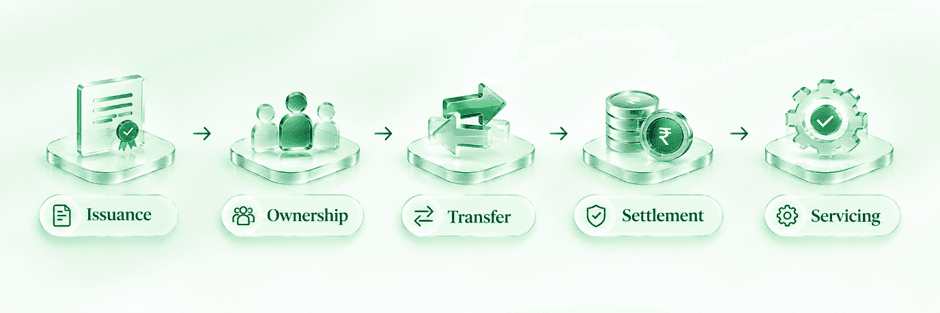
The underlying financial obligations do not disappear. Investors still need to meet applicable eligibility and KYC requirements, and issuers remain responsible for their obligations.
What changes is the infrastructure through which ownership, transactions and servicing can potentially be managed.
Why Does Bond Tokenization Matter for India?
India has a large bond market, but access and secondary-market liquidity remain important challenges.
The handbook estimates that approximately 97% of corporate bonds are issued through private placement, primarily serving institutional investors. It also notes that only around 2–3% of outstanding debt changes hands in the secondary market in a given year.
This creates a structural opportunity.
The issue is not necessarily a lack of capital or financial participants. It is that accessing, transferring and trading many corporate bonds can be difficult for smaller pools of capital.
Tokenization could potentially address some of these frictions by enabling securities to be represented in smaller digital units and by creating more programmable infrastructure for ownership, transfer and settlement.
However, tokenization should not be confused with an automatic solution for liquidity.
A token does not create a market by itself.
Buyers, sellers, issuers, intermediaries and distribution channels are still required.
India's Tokenization Infrastructure Is Already Taking Shape
India is not starting from scratch.
The development of bond tokenization infrastructure has happened in stages.
1. DLT infrastructure
SEBI mandated stock exchanges and depositories to develop a distributed ledger-based system for recording security creation and monitoring covenant compliance on secured corporate debentures.
NSDL and CDSL subsequently brought this DLT infrastructure live in April 2022.
2. Regulatory movement toward tokenization
SEBI has also moved toward testing tokenized debt securities through a pilot framework for tokenized corporate bond issuance and settlement.
The objective is to explore how tokenization can operate within regulated financial-market infrastructure rather than outside it.
3. Digital settlement
The next part of the stack is settlement.
The handbook identifies RBI's wholesale CBDC infrastructure and the Unified Market Interface as important components in the direction of digitally enabled financial-market settlement.
At the same time, the settlement layer remains an area where the market is still waiting for greater technical clarity and implementation detail.
The result is an interesting position for India:
The rails are developing, but the market built on top of them is still emerging.
The Potential Significance of a First Live Tokenized Bond
The handbook reports that Reuters described REC Limited as preparing a potential ₹5 billion tokenized bond issuance, with settlement through RBI's wholesale CBDC infrastructure.
The report deliberately treats this as reported but not confirmed, rather than presenting it as a completed transaction.
If confirmed and completed, such an issuance would be significant because it could connect multiple components of India's emerging tokenization stack in a real transaction.
Instead of asking:
Can India tokenize a bond?
the market could begin asking:
What can be built around tokenized bonds once the rails are connected?
That is a much larger opportunity.
What Actually Changes With a Tokenized Bond?
Tokenization can affect multiple stages of the bond lifecycle.
Issuance
Traditional corporate bonds can involve institutional lot sizes and processes designed around established intermediaries.
Tokenized infrastructure could enable securities to be represented in smaller digital units, subject to applicable regulatory and investor-eligibility requirements.
Transfer
Instead of relying entirely on traditional processes for recording ownership changes, tokenized infrastructure can enable ownership movements to be represented digitally.
Settlement
When compatible digital settlement infrastructure is available, tokenized securities can potentially interact with digital settlement assets, reducing friction in parts of the settlement process.
Servicing
Smart contracts can potentially automate elements of bond servicing, including coupon payments and covenant monitoring.
But some things do not change.
KYC remains necessary.
Regulatory requirements remain.
Investor eligibility remains.
Credit risk remains.
Tokenization changes the infrastructure. It does not eliminate the financial and regulatory fundamentals of the asset.
What Can India Learn From Global Tokenized Bond Markets?
India is entering this market alongside several jurisdictions experimenting with tokenized fixed income.
The approaches are different.
The United States has largely developed tokenized financial products within existing securities frameworks.
Singapore has focused heavily on market infrastructure and institutional experimentation through initiatives such as Project Guardian.
Hong Kong has used repeated government-backed digital bond issuances to build market familiarity and investor participation.
Switzerland has demonstrated how tokenized securities can operate within regulated financial-market infrastructure.
The global experience points to an important conclusion:
Regulatory clarity is necessary, but it is not sufficient.
Successful tokenized markets also require credible issuers, investor demand, settlement infrastructure, distribution and eventually secondary-market liquidity.
The Biggest Question: Can Tokenization Improve Liquidity?
This is where expectations need to remain realistic.
Tokenizing a bond does not automatically create a secondary market.
A liquid market needs buyers and sellers.
It needs pricing.
It needs distribution.
It needs trust.
It needs efficient settlement.
And it needs enough recurring activity to make trading worthwhile.
The handbook specifically cautions that thin secondary-market liquidity does not disappear simply because a bond becomes tokenized.
This is why the opportunity in bond tokenization in India may extend far beyond token creation.
The infrastructure around the token could be equally important.
Where Are the Opportunities?
Secondary-market infrastructure
A tokenized bond needs a compliant environment where eligible participants can buy and sell.
Developing secondary-market infrastructure could therefore become an important part of India's tokenized securities ecosystem.
Investor access
If regulations permit smaller denominations and broader participation, tokenization could potentially make selected fixed-income opportunities more accessible to smaller investors.
Digital onboarding
Tokenized securities still require KYC, AML and beneficial-ownership processes.
As investor participation expands, scalable digital onboarding becomes increasingly important.
Settlement
The convergence of tokenized securities with digital settlement infrastructure could create opportunities for more automated transaction flows.
Distribution
Even the best-designed tokenized bond needs investors.
Distribution may therefore become one of the most important layers in the tokenized bond ecosystem.
A technically successful product that cannot reach investors is still an incomplete market solution.
The GIFT City Opportunity
For businesses exploring tokenized financial assets with international capital in mind, GIFT City and the IFSCA ecosystem represent another route worth watching.
The handbook notes that IFSCA published a consultation paper in February 2025 covering the tokenization of real-world assets, including financial securities such as funds, bonds and stocks. Its fintech sandbox also provides a controlled environment for testing financial innovation.
This creates an interesting potential pathway for builders working at the intersection of:
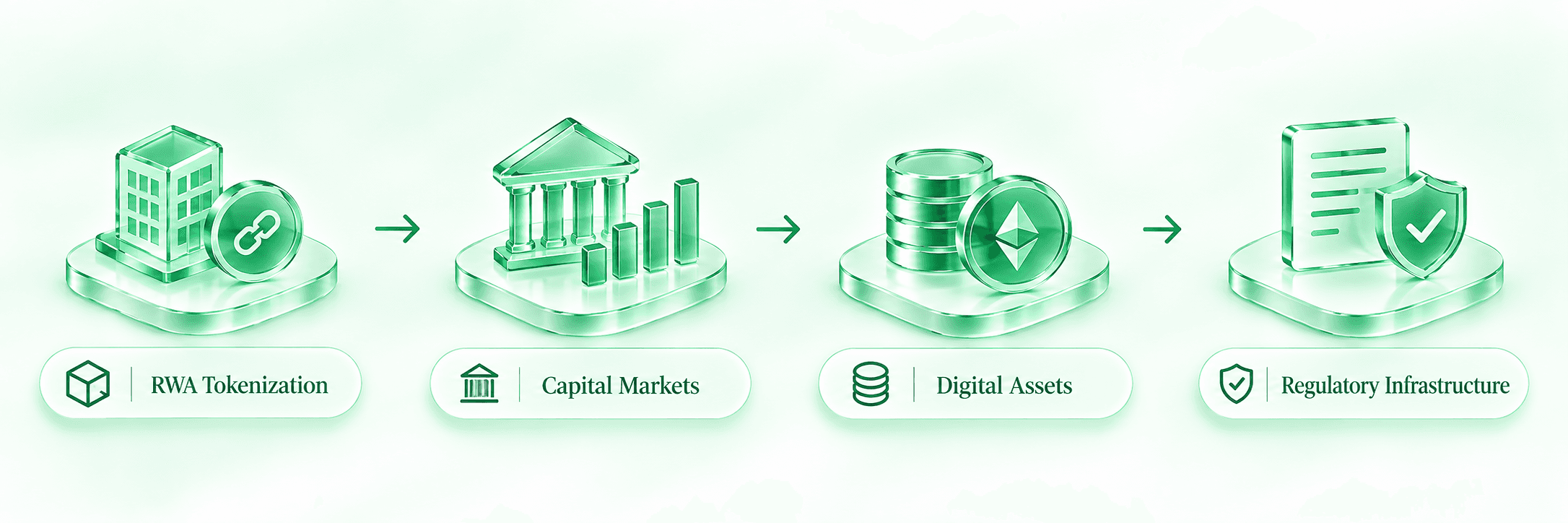
The exact route, however, depends on the structure of the product and the applicable regulatory framework.
What Tokenization Cannot Solve on Its Own
It is important not to overstate the technology.
Tokenization cannot independently solve:
• Credit risk
• Investor demand
• Lack of buyers and sellers
• Regulatory uncertainty
• Poor product design
• Insufficient distribution
• Market fragmentation
These are market-structure problems.
This is why the next stage of tokenization will likely be less about creating another token and more about building the infrastructure surrounding the token.
From Infrastructure to Adoption
The transition can be understood as a simple chain:
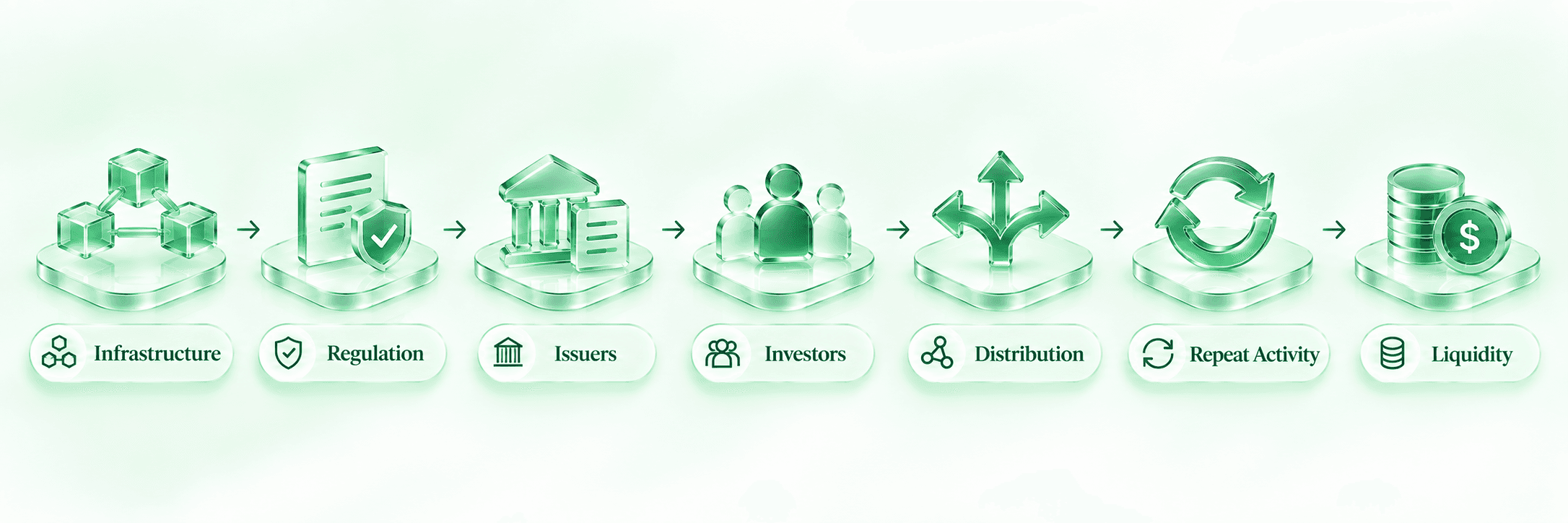
India has already made significant progress on the infrastructure side.
The next step is market development.
A functioning tokenized bond market needs all of these pieces to work together.
Infrastructure without issuers creates technology without transactions.
Issuers without investors create products without demand.
Investors without distribution create inaccessible opportunities.
And all of them without secondary-market activity create limited liquidity.
The opportunity is therefore not to rebuild the financial system from scratch.
It is to connect the systems that already exist.
What the Next Phase Could Look Like
The future of bond tokenization in India may not be defined by one large platform.
It could emerge through a network of specialized infrastructure providers working together.
One participant may focus on issuance.
Another may provide compliance infrastructure.
Another may manage custody.
Another may provide distribution.
Another may operate a trading venue.
Another may provide the technology connecting these layers.
This collaborative model could be more practical than expecting one organization to build the entire stack.
The handbook similarly highlights collaboration between issuers, regulated intermediaries, technology providers and distribution platforms as an important part of developing viable tokenized markets.
The Bigger RWA Tokenization Opportunity
Bond tokenization is part of a much larger transformation taking place across real-world assets.
Real estate, gold, funds, bonds and other financial assets can all potentially benefit from infrastructure that makes ownership, transfer, compliance and settlement more digitally native.
But the fundamental principle remains the same:
Tokenization is not simply about putting an asset on a blockchain.
It is about creating the infrastructure that allows the asset to move through a compliant digital financial ecosystem.
For bonds, that means connecting the asset with issuance, legal structuring, compliance, ownership, custody, settlement, servicing and distribution.
What Comes Next for India?
India's bond tokenization journey has reached a point where the technology itself is no longer the only question.
The more important question is adoption.
Will issuers return to tokenized issuance?
Will investors participate?
Will regulated intermediaries integrate the infrastructure?
Will secondary-market activity develop?
Will digital settlement rails become accessible to builders?
And can all these components work together at scale?
These are the questions that will determine whether tokenized bonds become a meaningful part of India's capital-market infrastructure.
Building the Next Layer of Tokenized Finance
At RyzerX, we see tokenization as an infrastructure opportunity rather than simply an asset-digitization exercise.
Our approach focuses on the layers required to move tokenized real-world assets from issuance toward practical market participation, including infrastructure, compliance, custody, distribution, liquidity and investor access.
As India moves toward a more connected tokenized financial ecosystem, the opportunity is no longer simply to ask whether an asset can become a token.
The more important question is:
What financial infrastructure can be built around it?
The next phase of India's bond market may be defined by the businesses, institutions and infrastructure providers willing to answer that question.
The token is only the beginning.
Explore Tokenization With RyzerX
If your institution is exploring bond tokenization, RWA tokenization, digital securities or tokenized capital-market infrastructure, RyzerX can help you think beyond the token and toward the complete ecosystem required for adoption.
Build the next generation of digital capital markets with RyzerX.
Stay informed with the latest guides and news.


