The Tokenisation Stack - What Happens After an Asset Becomes a Token?

Mantasha Tarannum
Tokenization
9
min read

Tokenization is often described as the process of turning a real-world asset into a digital token on a blockchain.
That description is technically correct, but it leaves out the most important part.
Creating the token is only the beginning.
Once an asset becomes a token, a much larger infrastructure has to operate behind it. The token needs to be legally connected to the underlying asset, issued according to defined rules, held securely, transferred between eligible investors, monitored for compliance, settled, valued and eventually redeemed or sold.
This entire infrastructure can be understood as the tokenization stack.
For real estate, private credit, bonds, funds, commodities, and other real-world assets, the tokenization stack acts as the bridge between traditional finance and blockchain-based markets.
What happens after the asset becomes a token?
1. Tokenisation Does Not End with Minting
Imagine a commercial property worth $10 million.
Instead of requiring one investor to purchase the entire property, the economic interests associated with the asset can be represented through 10 million digital units, with each token representing a defined economic or legal interest.
The blockchain can record who owns those tokens and enable them to be transferred digitally.
But several questions immediately arise:
Who legally owns the underlying property?
What exactly does one token represent?
Who issues the tokens?
Where is the underlying asset held?
Who verifies the investor?
Who can buy or sell the token?
How are transfers restricted?
How is the asset valued?
How are rental income, interest, or dividends distributed?
What happens if the underlying asset is sold?
How is the token redeemed?
What happens if an investor loses access to their wallet?
This is why tokenization is better understood as an end-to-end financial infrastructure, rather than simply a blockchain application.
2. The Tokenization Stack
A simplified tokenization stack can be divided into several interconnected layers:
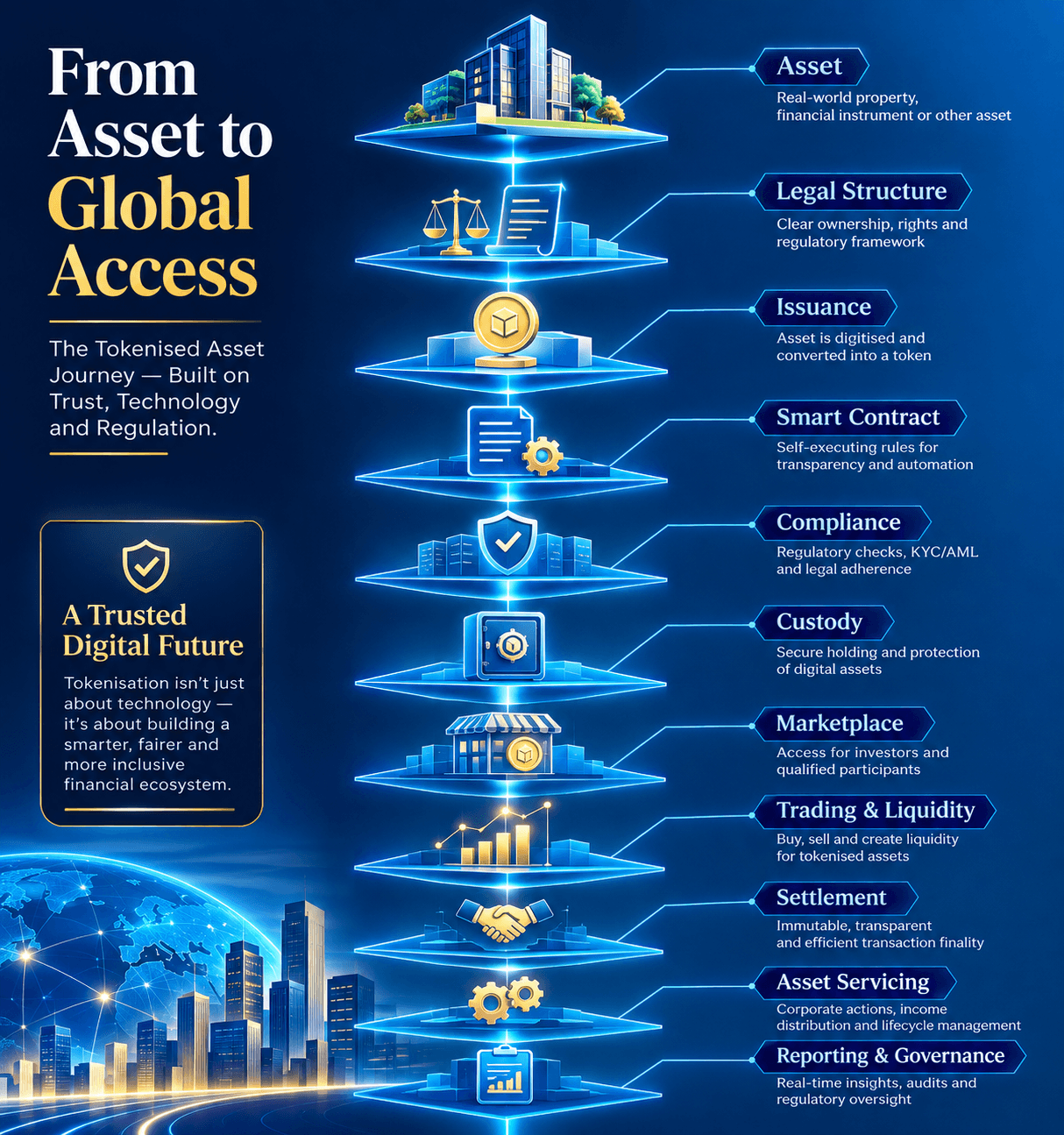
Each layer solves a different problem.
Let's break down what happens at each stage.
3. Layer One: The Underlying Asset
Everything starts with the real-world asset.
This could be:
Real estate
Government bonds
Corporate bonds
Private credit
Investment funds
Commodities
Infrastructure projects
Art and collectibles
Private equity
Intellectual property
The first step is determining exactly what is being tokenised.
This sounds straightforward, but it is one of the most important parts of the process.
A blockchain token does not automatically give its holder ownership of a physical asset.
For example, a token representing a building could represent:
Direct ownership of the property
Shares in a company that owns the property
A beneficial interest in a trust
A debt claim secured against the property
A contractual right to a portion of rental income
The legal structure determines what the investor actually owns.
The token is the digital representation. The legal structure establishes the economic and legal rights behind it.
4. Layer Two: Legal Structuring
This is where traditional finance and tokenisation meet.
Before tokens are issued, the issuer needs to determine how the underlying asset will be legally held and how investors will receive rights.
A common structure is the use of a special purpose vehicle, or SPV.
For example:
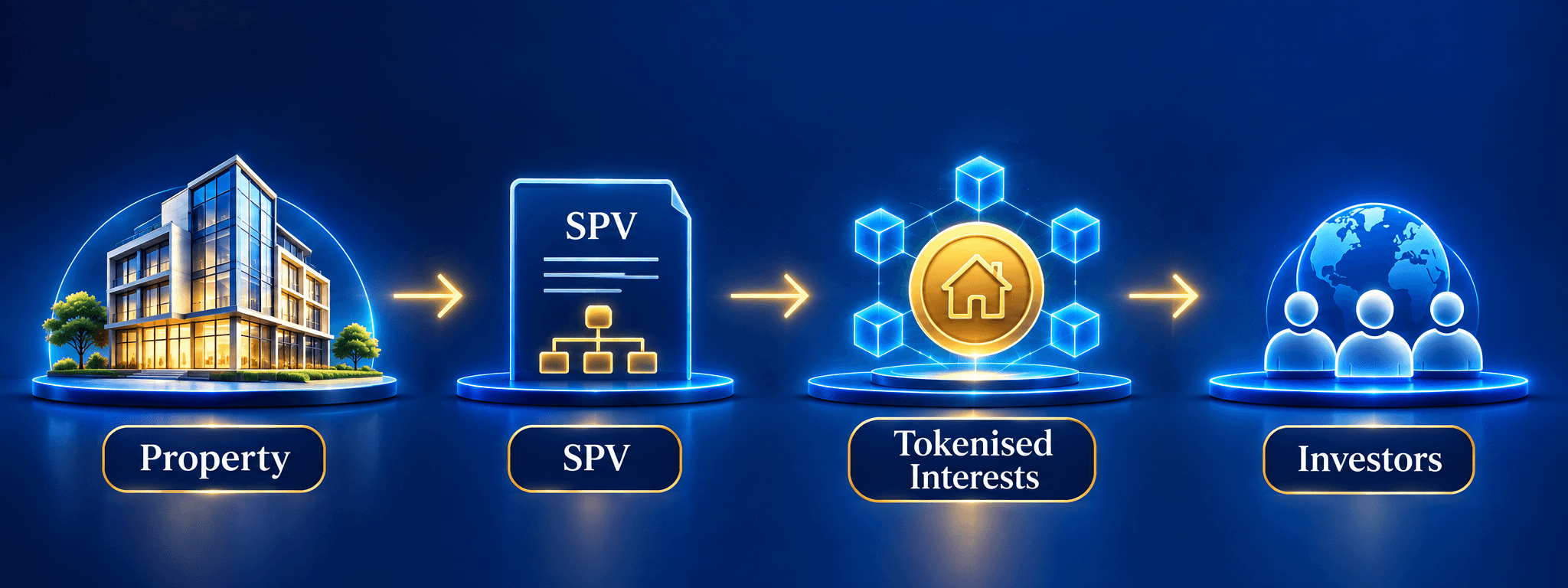
The SPV may legally own the property while investors hold tokens representing shares, interests or claims associated with the SPV.
The structure depends heavily on the jurisdiction and asset class.
This layer is critical because blockchain ownership and legal ownership are not automatically the same thing.
A technically sophisticated token with weak legal enforceability can still be a poor financial product.
5. Layer Three: Token Issuance
Once the legal structure is established, the asset can be represented digitally.
The issuer defines parameters such as:
Total token supply
Token price
Minimum investment
Investor eligibility
Transfer restrictions
Distribution rights
Voting rights
Redemption conditions
Maturity, where applicable
The tokens are then created or minted, on a blockchain.
For example, a $10 million asset could theoretically be represented by 10 million tokens at $1 each.
However, token supply does not necessarily have to equal the asset value one-for-one.
The important point is that the issuer defines what each token represents.
6. Layer Four: Smart Contracts
The token needs rules.
This is where smart contracts become important.
A smart contract is programmable blockchain logic that can automatically enforce predefined conditions.
For a tokenized security, the smart contract may determine:
Who can hold the token
Whether transfers are permitted
Whether an investor has completed KYC
Whether the token can be transferred across jurisdictions
How many tokens an investor can hold
Whether tokens are locked for a particular period
How distributions are calculated
This creates an important shift.
In traditional financial markets, many rules are enforced through intermediaries, databases, contracts, and operational processes.
Tokenization can embed some of those rules directly into the digital asset itself.
However, smart contracts do not replace legal agreements, regulators, custodians, or financial institutions. They operate as one part of the broader infrastructure.
7. Layer Five: Compliance and Investor Verification
Once tokens exist, the next challenge is determining who is allowed to own them.
This is particularly important for tokenized securities and regulated financial assets.
The platform may need to perform:
KYC: Know Your Customer
AML: Anti-Money Laundering checks
Accreditation or eligibility checks: Depending on the product and jurisdiction
Sanctions screening
Jurisdiction checks
Transaction monitoring
The result can be a permissioned token environment where only verified investors are allowed to purchase or transfer the asset.
This is one of the major differences between a regulated tokenized asset and a freely transferable cryptocurrency.
A token may technically be transferable on a blockchain, but the legal and regulatory framework may restrict who can actually receive it.
8. Layer Six: Custody and Wallet Infrastructure
Once investors acquire tokens, they need somewhere to hold them.
This brings us to custody.
Investors may hold tokens through:
Self-custody wallets
Institutional custodians
Qualified or regulated custody providers
Platform-controlled wallets
Hybrid custody arrangements
The infrastructure must protect private keys and ensure that only authorised parties can initiate transactions.
For institutional investors, custody becomes especially important.
An institution may require:
Multi-signature controls
Role-based permissions
Transaction approval workflows
Segregation of assets
Audit trails
Recovery procedures
Institutional reporting
This means the wallet is not simply a digital equivalent of a bank account.
It becomes part of the operational infrastructure for holding financial assets.
9. Layer Seven: Primary Marketplace
After issuance, investors need a way to purchase the tokens.
This is the primary market.
The issuer can offer tokens directly to eligible investors through a digital platform.
The process could look like this:
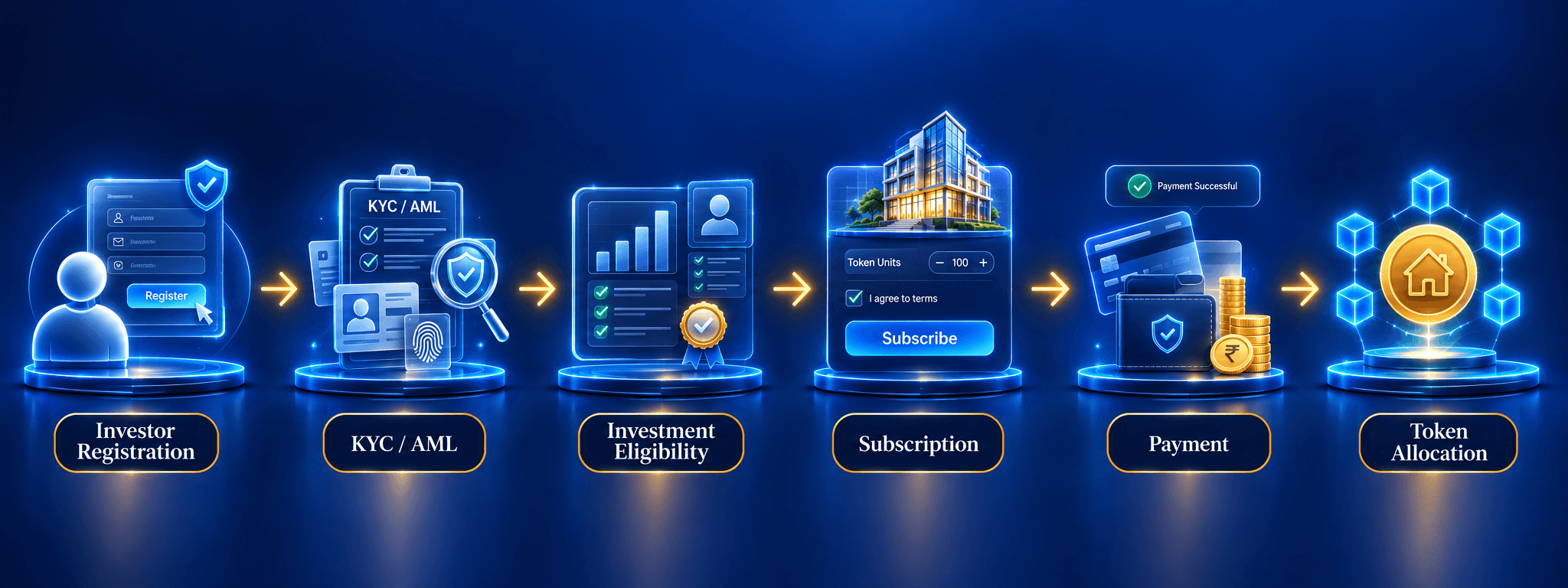
Payment may occur through traditional fiat currency or, depending on the platform and regulatory structure, approved digital settlement assets.
For example, an investor could subscribe to a tokenized bond and receive the corresponding tokens once the investment has been processed and settlement conditions have been satisfied.
The marketplace therefore connects capital with tokenized assets.
10. Layer Eight: Secondary Market and Liquidity
This is where tokenization becomes particularly interesting.
Traditional private-market investments can be difficult to trade.
Real estate is a classic example.
Selling a property can take months, involve lawyers, brokers, banks, documentation, and substantial transaction costs.
Tokenization does not magically eliminate these challenges.
But it can make the investment interest itself easier to transfer, subject to legal and regulatory restrictions.
A secondary marketplace can allow eligible investors to buy and sell tokenized assets.
The potential benefits include:
Fractional participation
Wider investor access
Faster transfers
Greater transparency
Lower operational friction
Potentially improved liquidity
But liquidity must not be confused with tokenization.
Putting an asset on a blockchain does not automatically create buyers.
A tokenized property can still have limited liquidity if there are few investors interested in purchasing it.
This is why distribution, market-making, investor networks, and secondary-market infrastructure are so important.
11. Layer Nine: Trading and Order Management
Once a secondary market exists, the platform needs mechanisms for trading.
Depending on the structure, this could include:
Order books
Broker-assisted transactions
OTC trading
Auction mechanisms
Peer-to-peer transfers
Automated market mechanisms
The choice depends on the asset, investor type, regulation, and liquidity profile.
For institutional assets such as bonds or private credit, OTC infrastructure can remain important because transactions may involve negotiated prices and large ticket sizes.
For more liquid assets, an exchange-style environment may be appropriate.
The key point is that tokenization creates the digital asset, but market infrastructure creates the market around it.
12. Layer Ten: Payment and Settlement
A trade is not complete merely because ownership changes on a blockchain.
The buyer also has to pay.
This creates the settlement layer.
Traditional financial markets may involve separate systems for:
Asset transfer + cash transfer + reconciliation
Tokenized markets can potentially bring these processes closer together.
One possibility is Delivery versus Payment or DvP.
Under a DvP model:
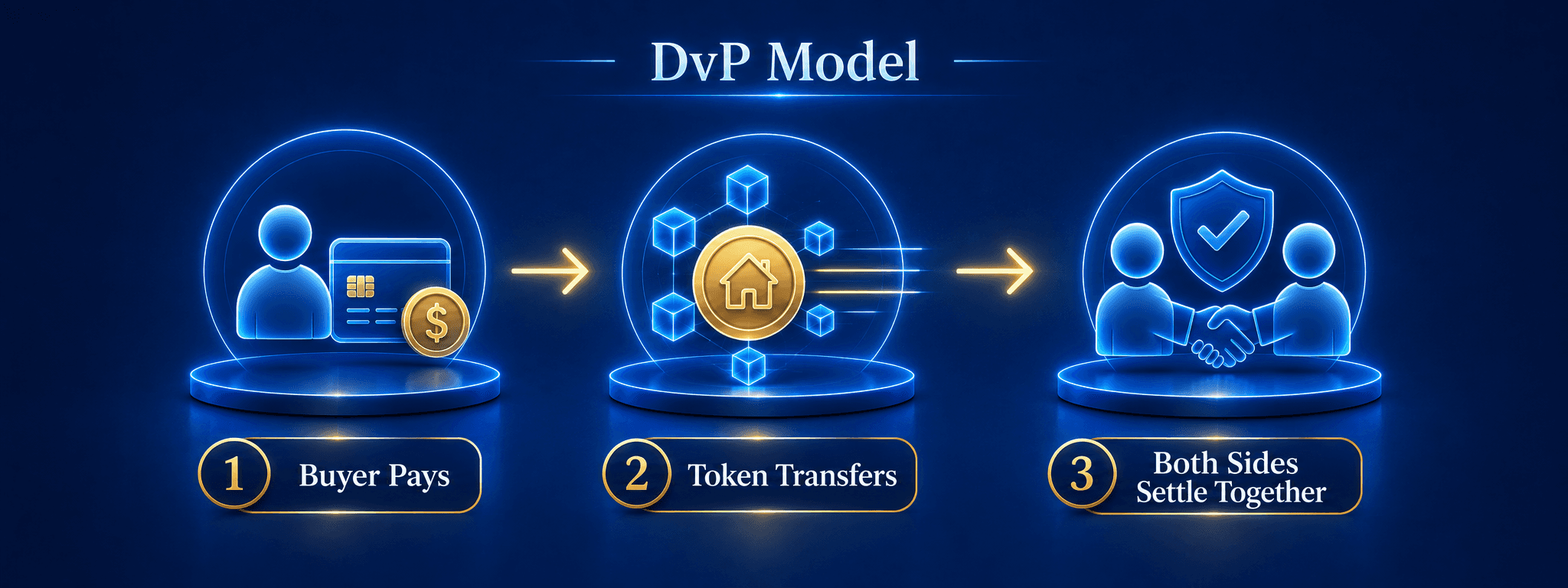
This reduces settlement risk because the asset and payment are linked.
Depending on the infrastructure, settlement may involve bank money, tokenized deposits, stablecoins, central bank money, or other regulated settlement mechanisms.
The long-term promise of tokenization is therefore not simply faster token transfers.
It is the possibility of creating programmable settlement infrastructure.
13. Layer Eleven: Asset Servicing
This is one of the most overlooked parts of tokenization.
After investors own the token, the underlying asset continues generating economic activity.
A property may generate rental income.
A bond may generate interest.
A fund may generate distributions.
A private credit instrument may generate repayments.
That income has to reach investors.
This creates the asset-servicing layer.
The system may need to manage:
Interest payments
Dividends
Rental distributions
Principal repayments
Redemptions
Corporate actions
Voting
Tax documentation
Investor statements
Smart contracts can automate portions of these processes, but the underlying financial information still has to come from reliable sources.
For example, if a token represents a share of rental income, the system needs verified information about actual rent collected, expenses, taxes, and distributable income.
This is where oracles and off-chain data infrastructure become important.
14. Layer Twelve: Oracles and Real-World Data
Blockchains are very good at recording what happens on-chain.
They are not naturally capable of knowing what happens in the physical world.
A blockchain does not automatically know:
Whether a property generated rent
Whether a borrower made a payment
Whether a building was damaged
What a property is currently worth
Whether an asset was sold
External information therefore needs to enter the blockchain through trusted data mechanisms, commonly referred to as oracles.
This creates a critical dependency.
The quality of a tokenized asset is influenced not only by the blockchain but also by the quality of the data connecting the blockchain to the underlying asset.
In simple terms:
Blockchain verifies digital transactions.
External data verifies real-world events.
Both are necessary for many forms of RWA infrastructure.
15. Layer Thirteen: Valuation and Transparency
Investors need to know what their token is worth.
For publicly traded assets, market prices may provide a relatively clear signal.
For private assets such as commercial real estate or private credit, valuation can be more complex.
The infrastructure may therefore include:
Independent valuations
NAV calculations
Asset performance reports
Financial statements
Property-level data
Cash-flow information
Risk disclosures
Blockchain can improve transaction transparency, but it does not automatically make the underlying asset transparent.
A tokenized property can have transparent ownership records while still having limited transparency regarding maintenance costs, occupancy, valuation methodology, or future cash flows.
On-chain transparency and real-world transparency are two different things.
16. Layer Fourteen: Risk Management and Monitoring
As tokenized markets become larger, platforms also need continuous monitoring.
This may include monitoring:
Investor activity
Suspicious transactions
Concentration risk
Liquidity risk
Counterparty exposure
Collateral value
Smart-contract vulnerabilities
Regulatory compliance
Wallet activity
For institutional markets, this layer becomes particularly important.
A tokenization platform is not simply a place where assets are minted.
It increasingly becomes a financial operating system that connects assets, investors, compliance systems, payment rails, custody, and market infrastructure.
17. Layer Fifteen: Redemption and Exit
Eventually, investors need an exit.
There are several possibilities.
An investor may:
Sell the token to another investor
or
Redeem the token with the issuer
or
Receive proceeds when the underlying asset matures or is sold
For a tokenized bond, redemption may happen at maturity.
For a tokenized fund, investors may redeem according to the fund's rules.
For real estate, the underlying property could eventually be sold and the proceeds distributed according to the token holders' rights.
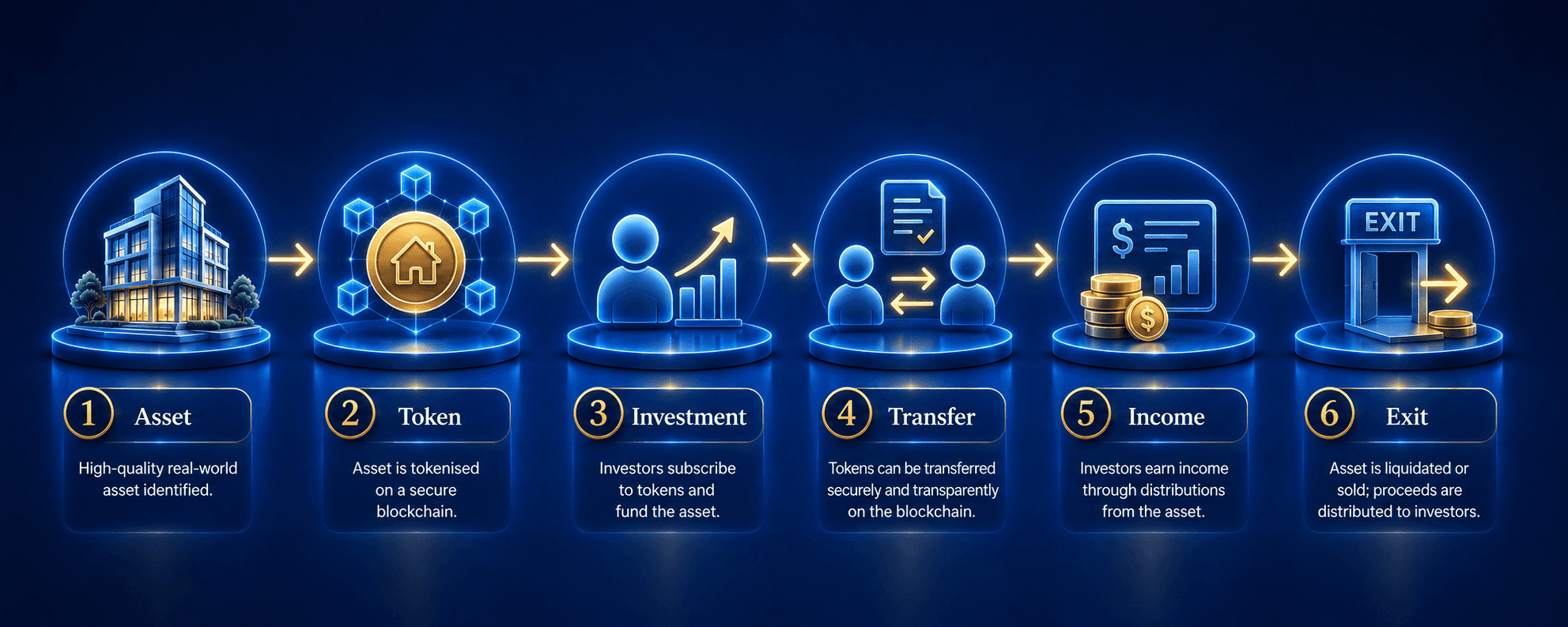
This brings the tokenization lifecycle full circle.
18. Who Actually Handles All of This?
A common misconception is that one tokenization platform performs every function.
In reality, a tokenized asset ecosystem can involve many participants.
Asset Owner
Owns or controls the underlying asset and initiates the tokenization process.
Issuer
Creates and distributes the tokenized investment.
Legal Advisors
Design the legal structure and investor rights.
Tokenization Platform
Provides the technology for issuance, management, trading, and investor interaction.
Blockchain Network
Records token ownership and transactions.
KYC/AML Providers
Verify investors and monitor compliance.
Custodian
Safeguards assets or private keys, depending on the structure.
Broker or Marketplace
Connects buyers and sellers.
Exchange or Trading Venue
Facilitates secondary-market transactions where permitted.
Payment Provider
Moves fiat or digital settlement assets.
Oracle/Data Provider
Connects verified real-world information to blockchain infrastructure.
Valuation Provider
Determines or supports the valuation of the underlying asset.
Auditor
Provides independent assurance over financial and operational information.
Regulator
Defines the legal and regulatory framework under which the activity operates.
The token is therefore only one component of a much larger ecosystem.
19. A Simple Example: What Happens to a Tokenized Building?
Consider a commercial building valued at $20 million.
The owner creates an SPV to hold the property.
The legal structure establishes that investors receive defined economic interests through the SPV.
The platform then issues 20 million tokens.
Each token represents a defined interest in the structure.
An investor completes KYC and purchases 5,000 tokens.
The tokens are transferred to the investor's approved wallet.
The property generates rental income.
The rental income is collected by the relevant asset manager or SPV.
After expenses and applicable obligations, the distributable income is calculated.
Investors receive their corresponding distribution.
Later, the investor wants to exit.
Instead of selling the entire building, the investor may be able to sell the tokens to another eligible investor through an approved secondary market.
If the property is eventually sold, the proceeds are distributed according to the legal rights attached to the tokenized structure.
Notice what happened.
The blockchain handled the digital representation and transfer of the investment interest.
But the entire economic lifecycle required legal, financial, compliance, custody, payment, valuation, and operational infrastructure around it.
That is the tokenization stack.
20. Why the Stack Matters More Than the Token
The biggest misconception around RWA tokenization is that the blockchain itself creates the value.
It does not.
The underlying asset creates the economic value.
The legal structure creates enforceable rights.
The token creates a programmable digital representation.
The compliance layer determines who can participate.
The marketplace creates access.
The secondary market creates potential liquidity.
The settlement layer enables transactions.
The servicing layer distributes economic benefits.
The data layer connects blockchain records with real-world events.
The governance layer keeps the entire system accountable.
This is why the future of tokenization will likely be determined less by who can mint tokens and more by who can build reliable infrastructure around those tokens.
21. The Emerging Institutional Tokenization Stack
As institutional adoption grows, tokenization platforms are increasingly moving toward integrated infrastructure.
A mature platform could combine:
Issuance
Asset onboarding, legal structuring, token creation and investor allocation.
Marketplace
Primary distribution and investor access.
Exchange
Secondary trading and liquidity.
OTC
Large or negotiated transactions.
Custody
Digital asset safeguarding and institutional wallet infrastructure.
Compliance
KYC, AML, eligibility and transaction monitoring.
Settlement
Payment and delivery of tokenized assets.
Asset Servicing
Income distributions, redemptions and corporate actions.
Data
Valuation, reporting, asset performance and external information.
Governance
Permissions, voting, disclosures and auditability.
The direction of travel is therefore toward a unified financial infrastructure rather than isolated tokenization applications.
22. What Changes for Investors?
For investors, the most visible change may be the ability to access assets through digital platforms.
But the deeper change is operational.
Instead of interacting with several disconnected systems, investors could eventually access:
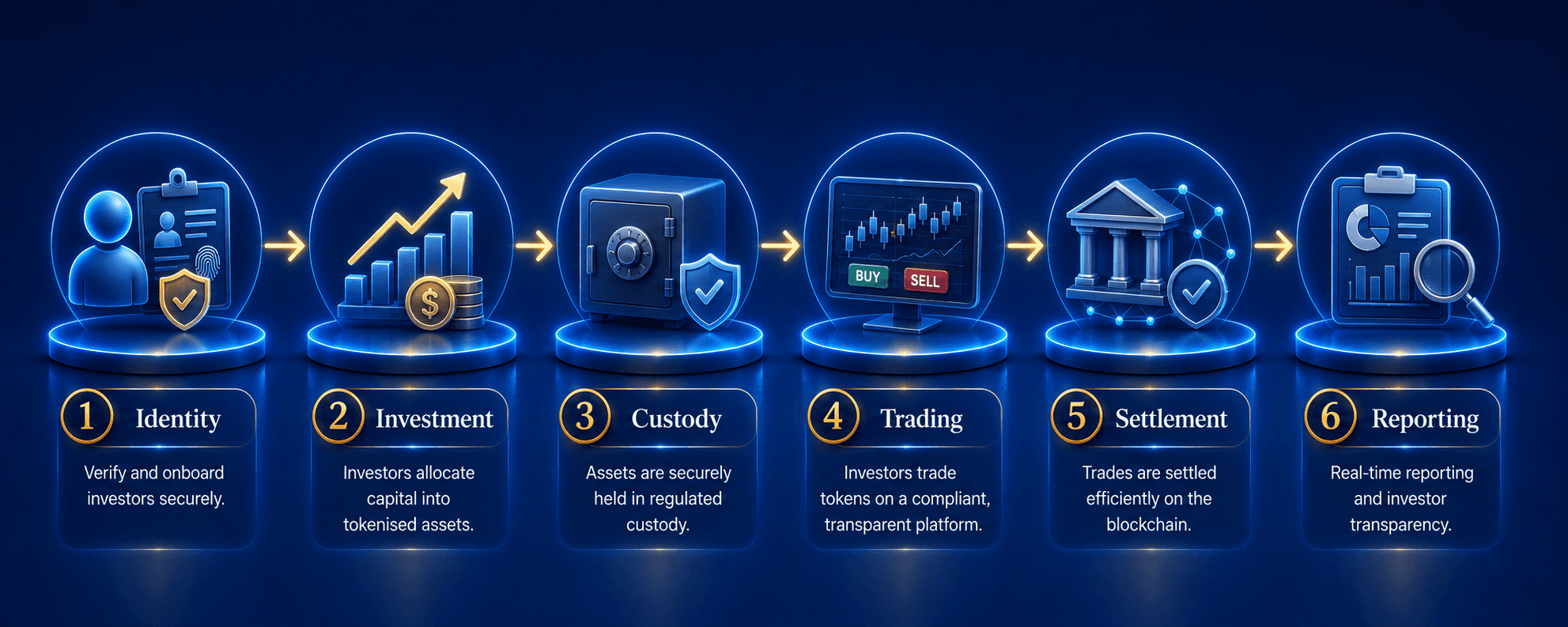
This is done through a much more integrated digital environment.
For certain assets, this could lower minimum investment requirements, reduce administrative friction, improve transparency, and potentially expand access.
But investors should still evaluate the fundamentals.
Tokenisation does not eliminate:
Market risk
Credit risk
Liquidity risk
Regulatory risk
Counterparty risk
Valuation risk
Technology risk
Asset-specific risk
A tokenised bad asset is still a bad investment.
Blockchain changes the infrastructure around an investment. It does not guarantee the quality of the investment itself.
23. The Real Promise of Tokenisation
The most important development in tokenisation may not be fractional ownership.
It may be the creation of programmable financial markets.
Imagine a bond where:
Ownership is recorded digitally
Investor eligibility is automatically checked
Transfers are restricted by smart-contract rules
Interest is distributed automatically
Settlement occurs digitally
Compliance records are generated continuously
Asset data is connected to the token
Investors can access secondary markets
Reporting is available in near real time
That is more than putting a traditional asset on a blockchain.
It represents a redesign of how financial assets can be issued, managed, transferred, settled, and serviced.
Conclusion: The Token Is Only the Beginning
The phrase tokenisation often makes the process sound simple:
Asset to Token
In reality, the complete infrastructure looks more like:
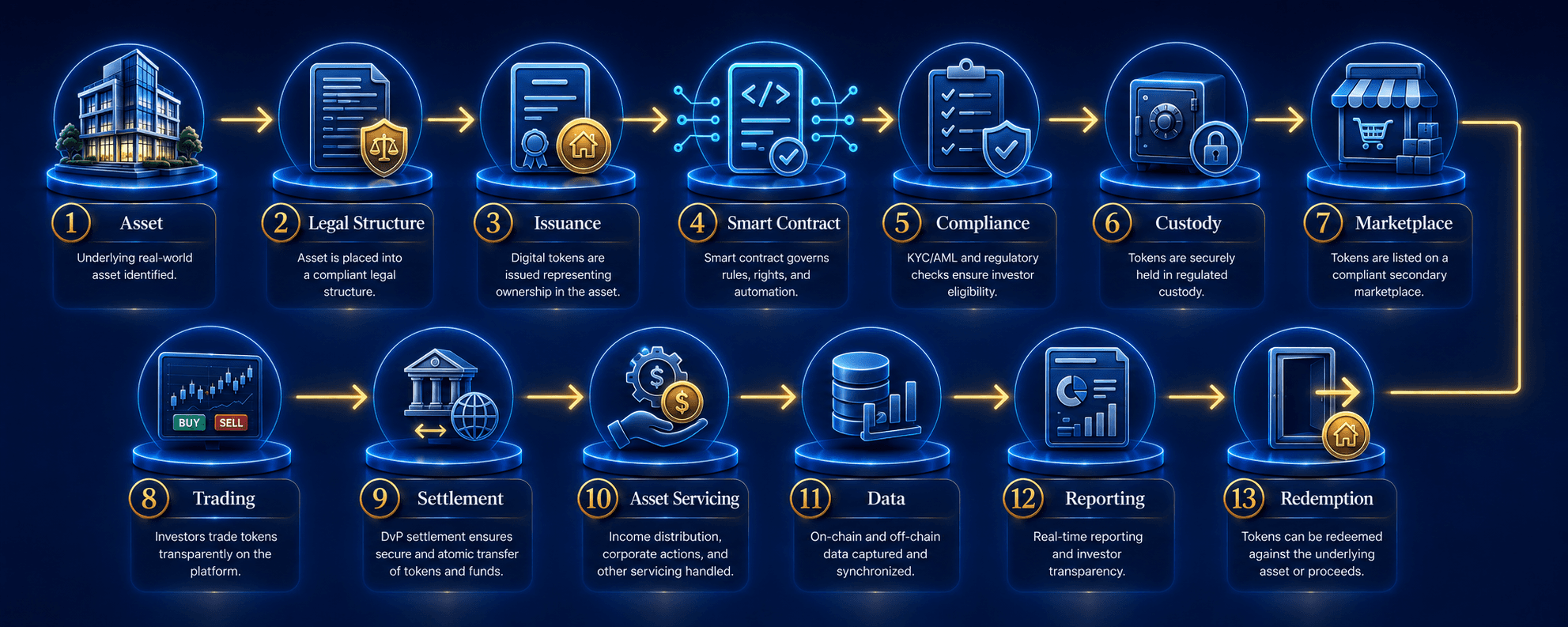
The token sits at the centre of this system, but it cannot operate in isolation.
The real opportunity in real-world asset tokenization lies in building the infrastructure that comes after the token is created.
That is where issuance becomes investment.
Investment becomes ownership.
Ownership becomes transferable.
Transfers become settlement.
Assets generate income.
Income reaches investors.
And eventually, the investor gets an exit.
The future of tokenization will not be defined simply by how many assets become tokens. It will be defined by how effectively the financial system can make those tokens usable, compliant, liquid, and connected to the real world.
That is the tokenization stack.
Stay informed with the latest guides and news.


