The Journey of Gold from Physical to Tokenised Asset

Mantasha Tarannum
Tokenization
10
min read

Gold has always had a physical problem.
It is valuable but it is also heavy, difficult to move, expensive to store and dependent on secure vaulting. As financial markets become increasingly digital, the obvious question is:
Can ownership of physical gold be represented digitally without losing the connection to the underlying asset?
India has already built two important answers to this question:
Electronic Gold Receipts (EGRs) and Bullion Depository Receipts (BDRs).
Both turn physical bullion into a dematerialized financial instrument. But they operate in different regulatory environments and market structures.
EGRs are part of India's SEBI-regulated Gold Exchange framework, while BDRs operate in GIFT IFSC under the IFSCA framework and are traded through the India International Bullion Exchange (IIBX). This distinction matters when discussing gold tokenization, because not every digital representation of gold is automatically a blockchain token.
What exactly is gold tokenization?
At its simplest, gold tokenization means creating a digital representation of a defined quantity of physical gold.
Imagine a vault contains:
1 kilogram of eligible gold
Instead of requiring every investor or market participant to physically handle that gold, the ownership or entitlement associated with it can be represented electronically.
The basic concept looks like this:
Physical Gold to Verified Vault to Digital Record to Transfer/Trade to Physical Redemption.
The digital instrument can make gold easier to transfer, trade and settle while the underlying bullion remains safely stored.
However, there is an important distinction.
Digital representation ≠ blockchain tokenization.
An EGR or BDR is digitally represented, but the regulatory framework does not require it to be a blockchain-based token.
These instruments are part of regulated market infrastructure involving exchanges, depositories, clearing corporations and
vault managers.
A blockchain-based gold token would add another technological layer, where ownership records and transfers could potentially be maintained using distributed ledger technology.
That makes EGRs and BDRs particularly interesting as examples of regulated digitalization of a real-world asset, even when they are not necessarily blockchain tokens.
1.What is an Electronic Gold Receipt (EGR)?
An Electronic Gold Receipt, or EGR, is a dematerialised instrument representing physical gold deposited in an eligible vault.
SEBI's framework treats EGRs as securities under the Securities Contracts (Regulation) Act. The framework was designed to create an organised Gold Exchange ecosystem where physical gold can be converted into EGRs, traded electronically and eventually converted back into physical gold.
Physical gold becomes an EGR
Gold is deposited with a SEBI-registered Vault Manager.
The vault verifies the gold and records the relevant information.
Once the required conditions are satisfied, the Vault Manager creates the EGR through the prescribed depository interface.
The corresponding EGR is then credited to the beneficial owner's demat account.
The key principle is simple:
No physical gold in the approved vault means no corresponding EGR should be created.
This is what connects the digital record to the underlying asset.
2. Who handles EGR?
EGR does not work through one company alone. It is an ecosystem.
SEBI
The Securities and Exchange Board of India (SEBI) is the primary regulator for the EGR framework.
It establishes the regulatory requirements covering the EGR ecosystem, including vault managers, exchanges and related
market infrastructure.
Vault Managers
The Vault Manager is responsible for the physical gold.
Its responsibilities include:
• receiving eligible gold
• verifying and recording the bullion
• safely storing the gold
• creating EGRs
• facilitating withdrawal
• extinguishing EGRs when physical gold is withdrawn
• maintaining reconciliation between physical gold and EGR records
SEBI's framework specifically requires the underlying physical gold to correspond with the EGRs created.
Depositories
Depositories such as NSDL and CDSL maintain the EGRs in dematerialised form.
They also coordinate the records between the EGR system and the vault infrastructure.
Stock Exchanges
Recognised exchanges provide the platform on which EGRs can be traded.
The NSE, for example, currently describes its EGR ecosystem as involving SEBI, exchanges, clearing corporations,
depositories and vault managers.
Clearing Corporation
Once an EGR trade takes place, the clearing corporation handles settlement between the buyer and seller.
The EGR moves to the buyer while the corresponding funds move to the seller.
3. How does EGR work?
Consider a simple example.
Suppose a participant deposits 100 grams of eligible gold with an approved vault.
The process is:
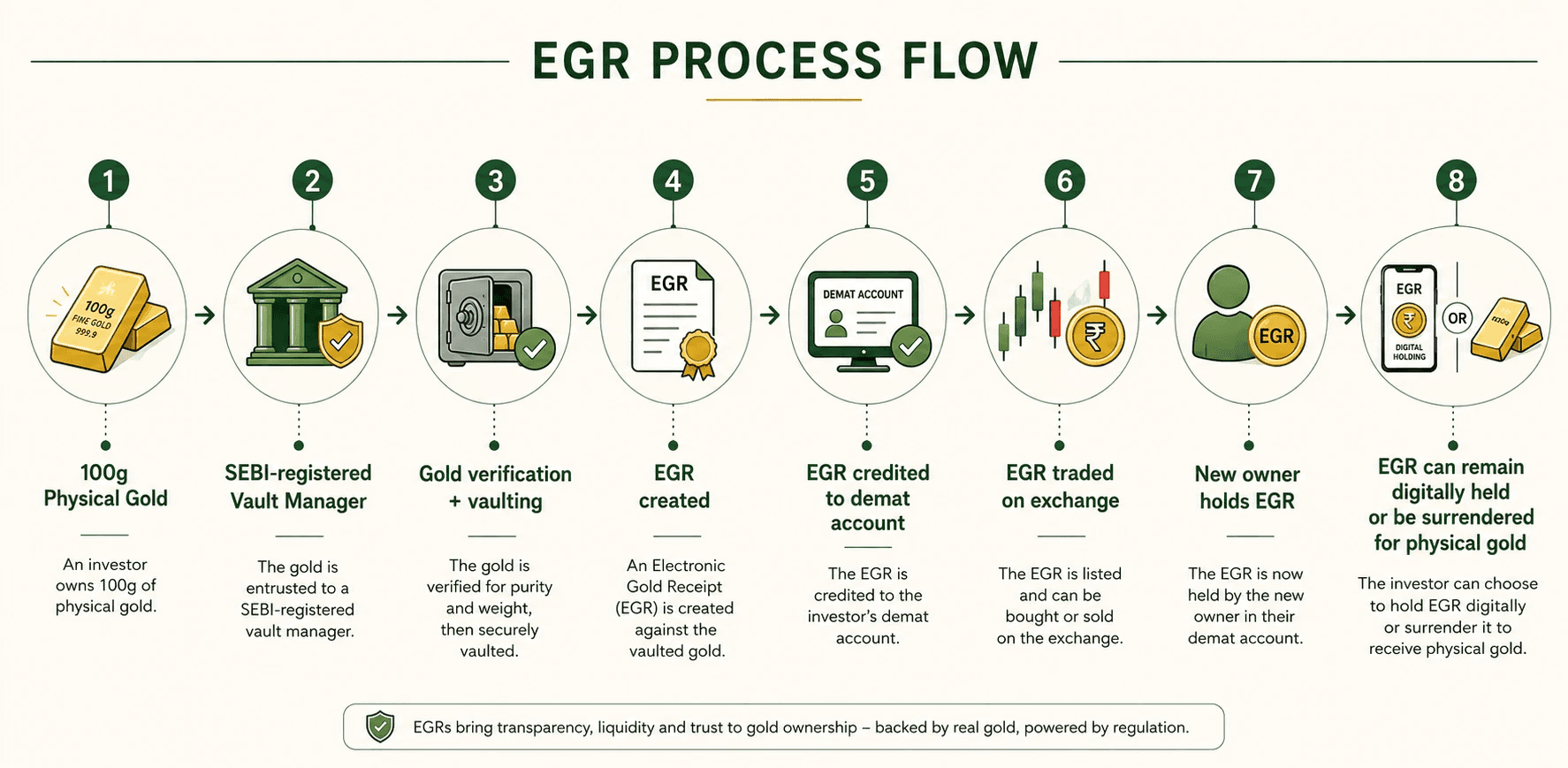
This is essentially a bridge between the physical bullion market and the securities market.
SEBI's framework divides the process into three tranches:
Conversion of physical gold into EGR
Trading of EGR on stock exchanges
Conversion of EGR back into physical gold
That three-stage architecture is one of the most important things to understand about India's approach to gold digitization.
4.What happens when someone wants the physical gold
Tokenization only becomes meaningful if the digital representation maintains a credible connection with the underlying asset.
With EGRs, an investor who wants physical gold can request a withdrawal.
The process broadly works as:
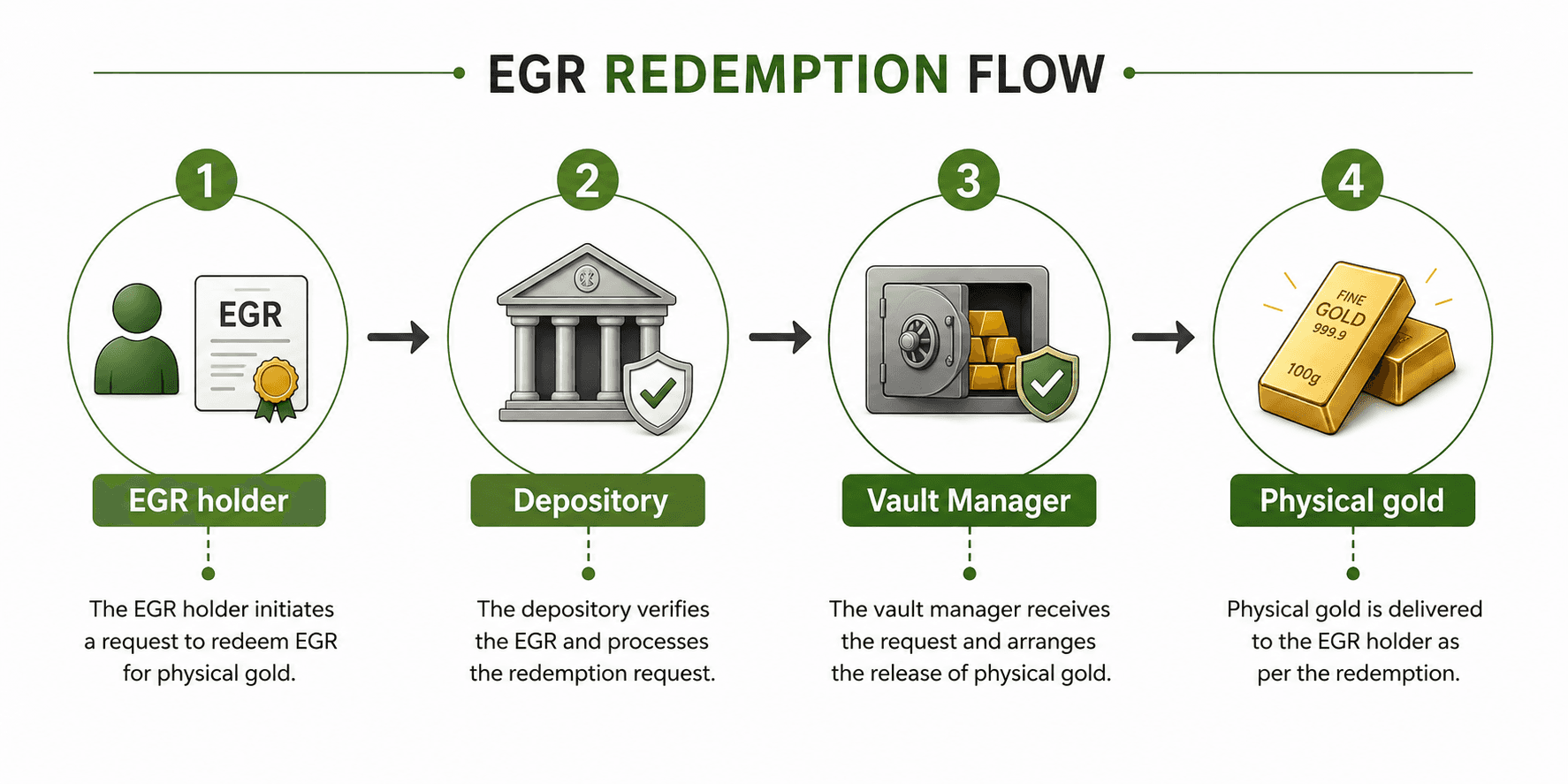
The corresponding EGR is extinguished when the physical gold is delivered.
This creates a two-way system:
Gold to EGR and EGR to Gold
The second transaction is particularly important because it prevents the digital representation from becoming detached from the underlying bullion.
5. What is a Bullion Depository Receipt?
Now comes the second instrument: the Bullion Depository Receipt or BDR.
BDRs operate primarily within India's GIFT IFSC bullion market, under the regulatory framework administered by the
International Financial Services Centres Authority (IFSCA).
The Government of India recognised Bullion Depository Receipts with underlying bullion as a financial product and related services as financial services.
The central marketplace is the India International Bullion Exchange (IIBX) in GIFT City.
A BDR represents specified bullion deposited in an approved vault and is maintained electronically through the bullion
depository infrastructure.
6. How does BDR work?
The BDR process is also based on a simple principle:
Physical bullion first. Digital receipt second.
Suppose a qualified supplier has a 1 kg gold bar.
The process broadly looks like this:
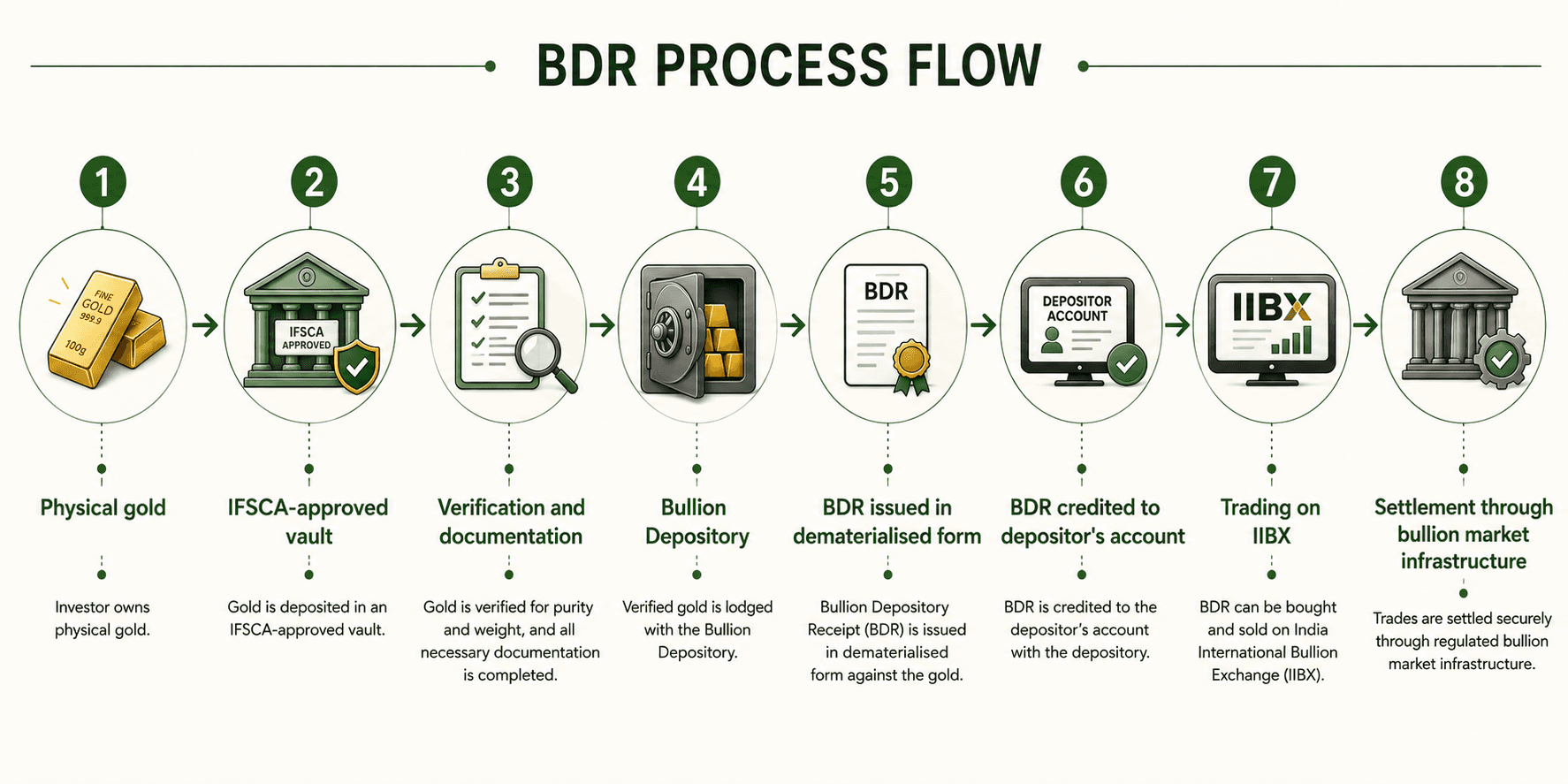
The IIBX explains that the depositor first deposits bullion with an identified vault, after which the Vault Manager verifies the
documentation and bullion. The bullion depository then issues the BDR in dematerialised form with a unique BDR number.
7. Who handles BDR?
The BDR ecosystem is different from the EGR ecosystem.
IFSCA
The International Financial Services Centres Authority (IFSCA) is the regulator for the financial services ecosystem in GIFT IFSC.
IFSCA's bullion-market framework covers the exchange, clearing, depository and vault infrastructure.
IIBX
The India International Bullion Exchange provides the trading infrastructure for bullion products.
It enables participants to trade bullion-related contracts and settle transactions through the bullion market infrastructure.
India International Depository IFSC
The India International Depository IFSC Limited (IIDI) acts as the bullion depository and issues BDRs electronically.
IIBX states that BDRs are issued by IIDI, which acts as the depository for trades executed on the exchange platform.
Vault Manager
The Vault Manager is responsible for the physical bullion.
It verifies and stores the gold in an approved vault and provides the information necessary for creation and extinguishment of BDRs.
Clearing Corporation
The bullion clearing infrastructure handles the settlement of trades by transferring BDRs and corresponding funds between
participants.
8. EGR vs BDR: What is the difference?
Feature | EGR | BDR |
|---|---|---|
Full Form | Electronic Gold Receipt | Bullion Depository Receip |
Main regulatory framework | SEBI | IFSCA |
Main Market | Indian securities market | GIFT IFSC bullion market |
Exchange | Recognised stock exchanges, including NSE's EGR segment | IIBX |
Underlying Asset | Physical Gold | Physical Bullion |
Digital holding | Demat form | Dematerialized form |
Depository infrastructure | NSDL/CDSL | IIDI |
Vaulting | SEBI-registered Vault Managers | IFSCA-approved vault infrastructure |
Trading | EGR segment | Bullion exchange |
Physical delivery | Possible through extinguishment | Possible through BDR extinguishment/withdrawal mechanism |
Primary market orientation | Gold investment and exchange trading | International bullion trading and delivery |
The important point is that EGR and BDR are not simply two names for the same product. They sit within different regulatory and market infrastructures.
9. So where does blockchain come into the picture?
This is where the conversation becomes particularly interesting for Real World Assets (RWAs).
EGR and BDR already demonstrate something fundamental:
A physical asset can be converted into a regulated digital representation while the underlying asset remains in institutional custody.
Blockchain tokenization takes this concept one step further.
Instead of maintaining ownership records solely through conventional securities or depository infrastructure, a tokenization platform could potentially represent claims or interests in gold through blockchain-based tokens.
Conceptually:
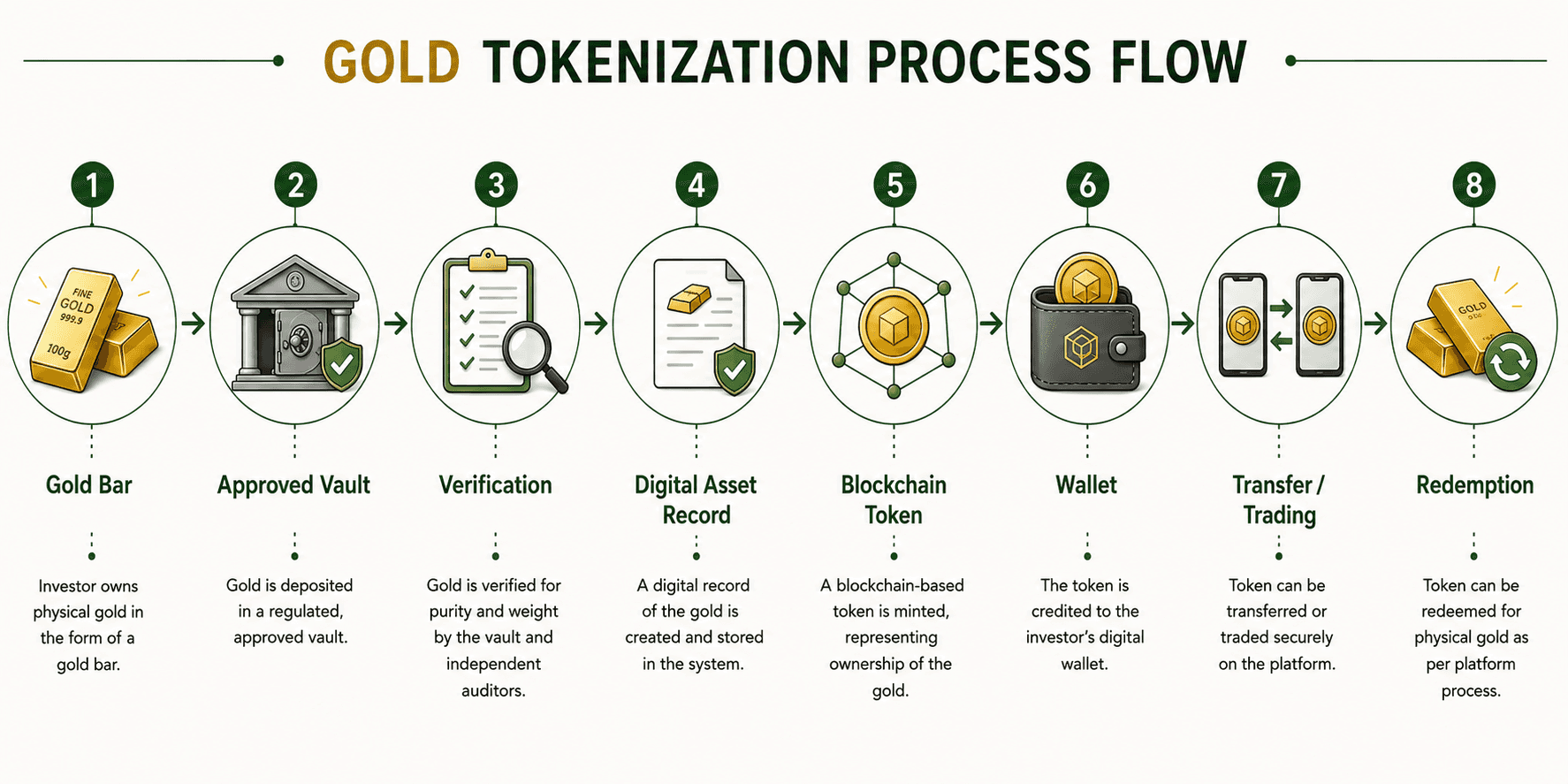
The blockchain could provide features such as programmable transfers, transparent transaction histories, automated
compliance rules and interoperability with other digital financial infrastructure.
But the blockchain itself does not create the gold.
The real asset still needs to exist somewhere.
This is why tokenised gold requires at least two layers:
The physical layer
Where the gold actually exists.
The digital layer
Where ownership or entitlement is represented.
The critical question is therefore not simply:
Is the gold token on blockchain?
It is:
Can the token holder establish a legally enforceable claim over identifiable underlying gold?
That is the heart of RWA tokenisation.
10. Why the vault is more important than the blockchain
A common misconception about tokenised gold is that blockchain is the most important part.
It isn't.
The blockchain can tell us who owns a token.
It cannot, by itself, tell us whether the gold supposedly backing that token actually exists.
That requires:
• secure vaulting
• independent verification
• purity standards
• serialisation or identification
• reconciliation
• audits
• legal ownership arrangements
• redemption mechanisms
India's EGR framework explicitly requires reconciliation between EGR records and the physical gold held in vaults.
This creates an important principle for every gold-tokenisation project:
Digital scarcity must be backed by physical scarcity.
If a platform creates 1 million digital gold tokens but only holds enough gold to support 500,000 tokens, the technology does
not solve the problem.
It creates a new one.
11. EGR and BDR are not the same as Digital Gold
This distinction is extremely important for investors.
People often use the terms:
Digital Gold
Electronic Gold Receipt
Bullion Depository Receipt
Tokenised Gold
as if they mean the same thing.
They don't.
SEBI specifically cautioned investors in November 2025 that online Digital Gold/E-Gold products offered by certain
platforms are different from SEBI-regulated products such as EGRs and Gold ETFs. SEBI stated that such Digital Gold
products are not notified as securities or regulated as commodity derivatives and therefore do not receive the same securities-market investor protection framework.
So we can think about the market as three different layers:
Digital Gold
A commercial product offered by private platforms.
EGR / BDR
Regulated financial-market instruments representing underlying bullion.
Blockchain-based Gold Token
A blockchain-native digital representation of gold, whose regulatory and legal treatment depends on its structure and
jurisdiction.
The third category should not automatically be described as equivalent to EGR or BDR.
12. Why EGR and BDR matter for RWA tokenization
The significance of EGR and BDR goes beyond gold.
They demonstrate how financial markets can digitize ownership of a physical asset while maintaining institutional custody.
The same architecture can potentially inspire tokenization models for: Gold, Real Estate, Bonds, Funds, Commodities and other RWAs.
The basic architecture remains similar:
→ Real Asset
→ Custodian/Vault
→ Verification
→ Digital representation
→ Ownership record
→ Trading
→ Settlement
→ Redemption
This is why gold is often considered one of the most intuitive assets for tokenisation.
It is highly standardized, globally traded, relatively easy to value and capable of being stored centrally.
13. What are the benefits?
Fractional ownership
Digital representations can make it easier to divide ownership into smaller units, depending on the specific product structure.
Improved liquidity
Instead of physically moving gold between buyers and sellers, the digital instrument can be transferred or traded while the
bullion remains in the vault.
Transparency
A properly designed infrastructure can provide stronger visibility into ownership, transactions and underlying asset records.
Reduced physical handling
The gold does not need to physically move every time ownership changes.
Standardization
Gold can be defined according to specific purity, weight and quality standards.
Faster settlement
Digital settlement can reduce the operational complexity associated with physical bullion movement. IIBX, for example, uses BDR-based settlement mechanisms, including 30-minute BDR settlement cycles for certain T+0 contracts.
14. But tokenization does not eliminate risk
Digitalization changes the form of ownership. It does not eliminate investment risk.
There are several risks to consider.
Custody risk
Where is the physical gold stored?
Who operates the vault?
Counterparty risk
Who legally owes the gold to the holder?
Redemption risk
Can the holder actually receive physical gold?
Regulatory risk
Which regulator governs the instrument?
Technology risk
If blockchain is involved, what happens if the platform, smart contract or wallet infrastructure fails?
Legal risk
Does holding the token legally mean owning the underlying gold, or does it represent a contractual claim?
Price risk
Gold itself remains a market-priced asset. Tokenization does not protect an investor from gold-price fluctuations.
15. The future: from EGR and BDR to tokenized gold
India's EGR and BDR frameworks show that the country's gold market is already moving beyond purely physical ownership.
EGR creates a regulated electronic route within India's securities-market infrastructure.
BDR creates an electronic bullion-delivery and trading mechanism within GIFT IFSC.
Blockchain-based tokenization could potentially build another layer on top of this evolution.
The progression can be understood as:
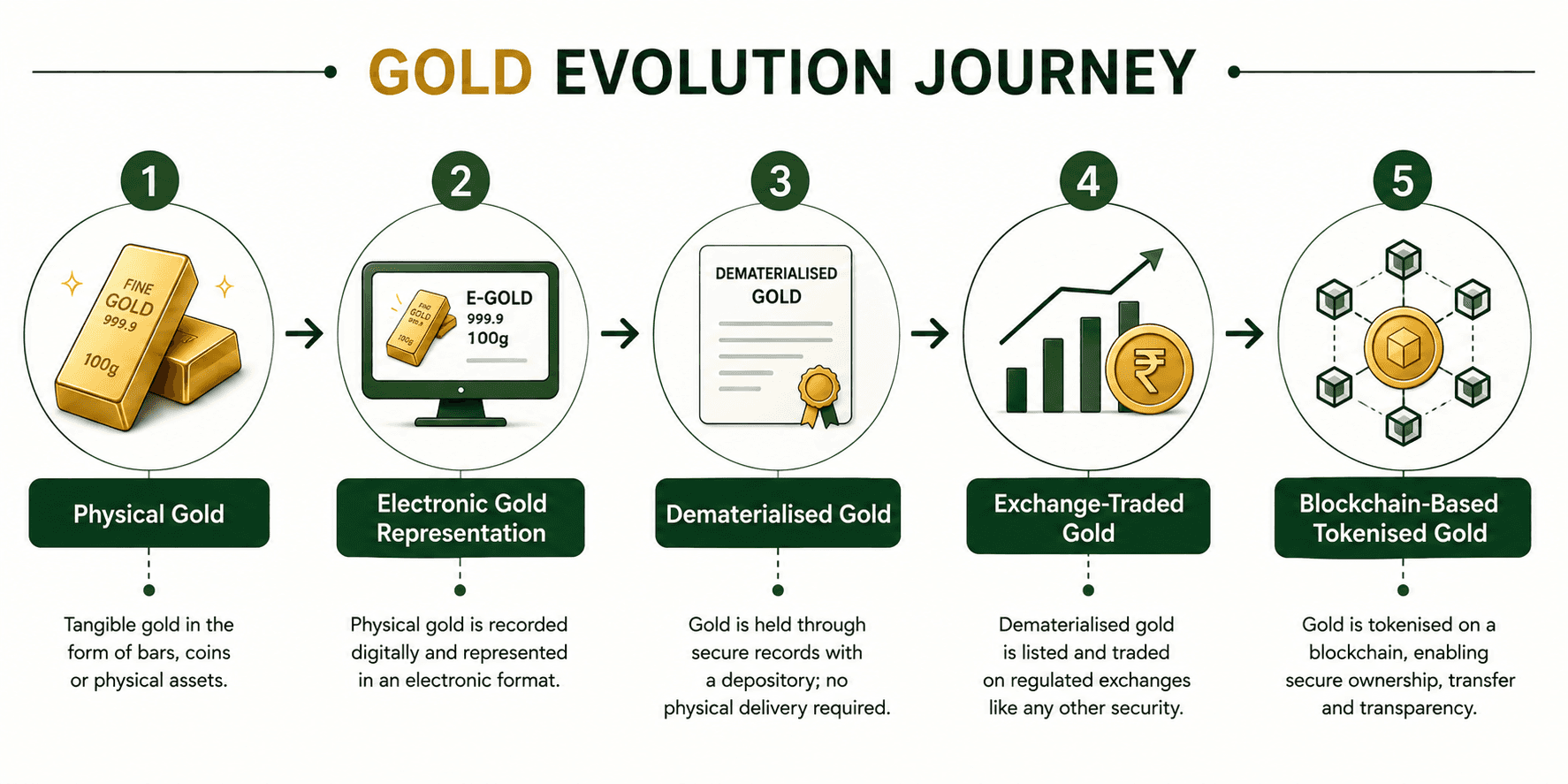
The last step is where RWAs become particularly interesting.
Imagine a future in which a verified gold bar is deposited into an institutional vault, its characteristics are recorded, its
ownership is represented digitally, and a blockchain token can be transferred between compliant investors while the physical
gold never leaves the vault.
That would transform gold from simply being a physical commodity into a programmable financial asset.
But the success of such a model will depend less on the token itself and more on the infrastructure behind it: custody, regulation, legal enforceability, verification, settlement and redemption.
The bigger picture
EGR and BDR show that gold tokenization does not begin with blockchain.
It begins with trust.
The physical gold has to exist.
Someone has to verify it.
Someone has to store it.
Someone has to maintain the ownership record.
Someone has to regulate the market.
Someone has to settle transactions.
And, most importantly, someone has to make sure that the digital representation can be connected back to the underlying asset.
That is the real lesson from India's gold infrastructure.
Tokenization is not about putting an asset on a blockchain. It is about building a trusted bridge between the physical
asset and its digital ownership.
EGRs and BDRs are two important examples of that bridge already operating within India's regulated financial infrastructure.
Blockchain-based tokenization represents the next possible evolution, but its value will ultimately depend on whether the
digital token has a clear legal claim, credible custody and reliable redemption mechanism behind it.
In other words:
The future of tokenized gold will not be determined by the token alone. It will be determined by what stands behind
the token.
Stay informed with the latest guides and news.


