India's from Regulatory Experiments to Digital Real Estate Infrastructure

Mantasha Tarannum
Tokenization
6
min read

India's real estate market is enormous, but access to it remains relatively illiquid, capital-intensive and fragmented. A commercial property worth hundreds of crores cannot easily be divided, transferred or accessed by a wider pool of investors.
Transactions often involve developers, banks, lawyers, registrars, valuers, brokers, custodians and regulators.
Real estate tokenization could change this structure.
Tokenization involves representing an economic or ownership interest in a real-world asset through digital tokens recorded
using blockchain or distributed ledger technology. Depending on the legal structure, these tokens may represent interests in a fund, SPV, security, debt instrument or other regulated investment vehicle.
But tokenization does not simply mean putting land ownership on a blockchain.
For institutional investors, its real value lies in connecting real-world assets with digital issuance, compliance, custody, settlement and potentially secondary-market liquidity.
India has started building these foundations.
The country does not yet have a nationwide framework allowing ordinary land titles to be directly converted into freely tradable blockchain tokens. Instead, institutional readiness is developing through multiple initiatives spanning land digitization, regulated fractional real estate, CBDCs, capital-market technology, GIFT IFSC and real-world-asset tokenization.
Digitizing the Foundation
Tokenization cannot solve problems in the underlying asset.
If property ownership is disputed, fragmented or poorly recorded, putting the information on blockchain does not make it legally reliable.
India's Digital India Land Records Modernization Programme (DILRMP) is therefore an important foundation. It focuses on digitizing land records, cadastral maps and registration processes and integrating land and registration databases.
The Department of Land Resources has also identified blockchain as a potential technology for secure and tamper-resistant land records.
Another important development is the Unique Land Parcel Identification Number (ULPIN), often called Bhu-Aadhaar.
ULPIN provides a unique identification number for individual land parcels and has been introduced across a growing number of States and Union Territories.
India is also developing NAKSHA, a geospatial programme designed to create GIS-integrated urban land databases.
These initiatives are not tokenization platforms.
Their importance is that they improve the digital identity and information layer of the underlying real estate asset.
A future tokenized property ecosystem could potentially connect:
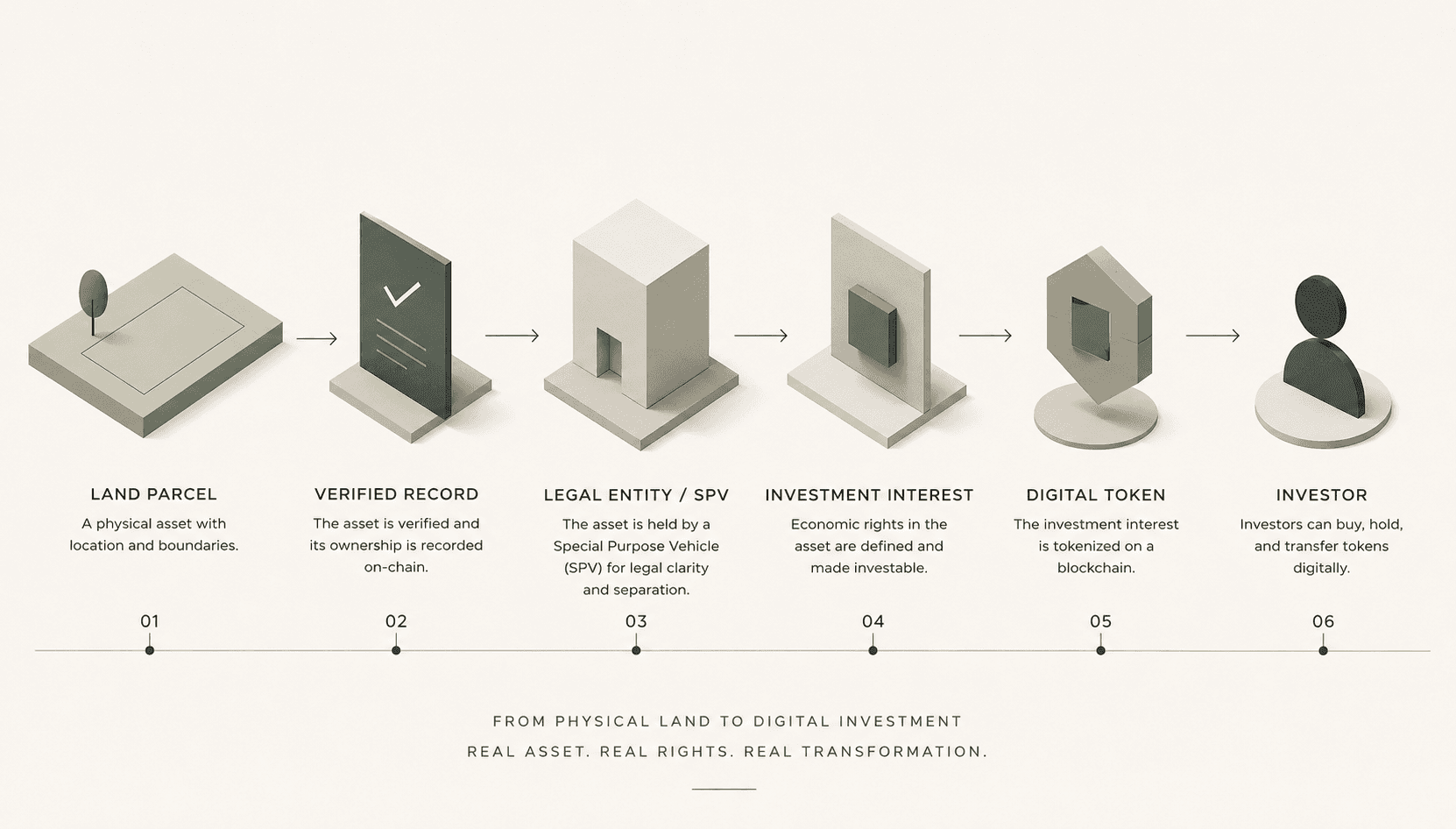
The image demonstrates the transformation of a physical real-estate asset into a digitally investable asset through tokenisation.
India's Blockchain Strategy
India's interest in blockchain for land and property is not new.
NITI Aayog's Blockchain: The India Strategy explored blockchain applications in areas including land records and property ownership. The National Strategy on Blockchain also identified land and property as potential use cases.
The policy direction was significant because blockchain was increasingly being viewed as infrastructure for trusted records and financial systems rather than only as cryptocurrency technology.
This distinction has become increasingly important as India moves toward tokenised financial assets.
RBI's Digital Rupee
The Reserve Bank of India's Central Bank Digital Currency programme represents another important piece of the future tokenisation ecosystem.
The wholesale digital rupee, or e₹-W, pilot began in November 2022 and initially focused on settlement of secondary-market transactions in government securities.
The significance for tokenised real estate is indirect.
A mature tokenised market needs both: digital assets + digital settlement
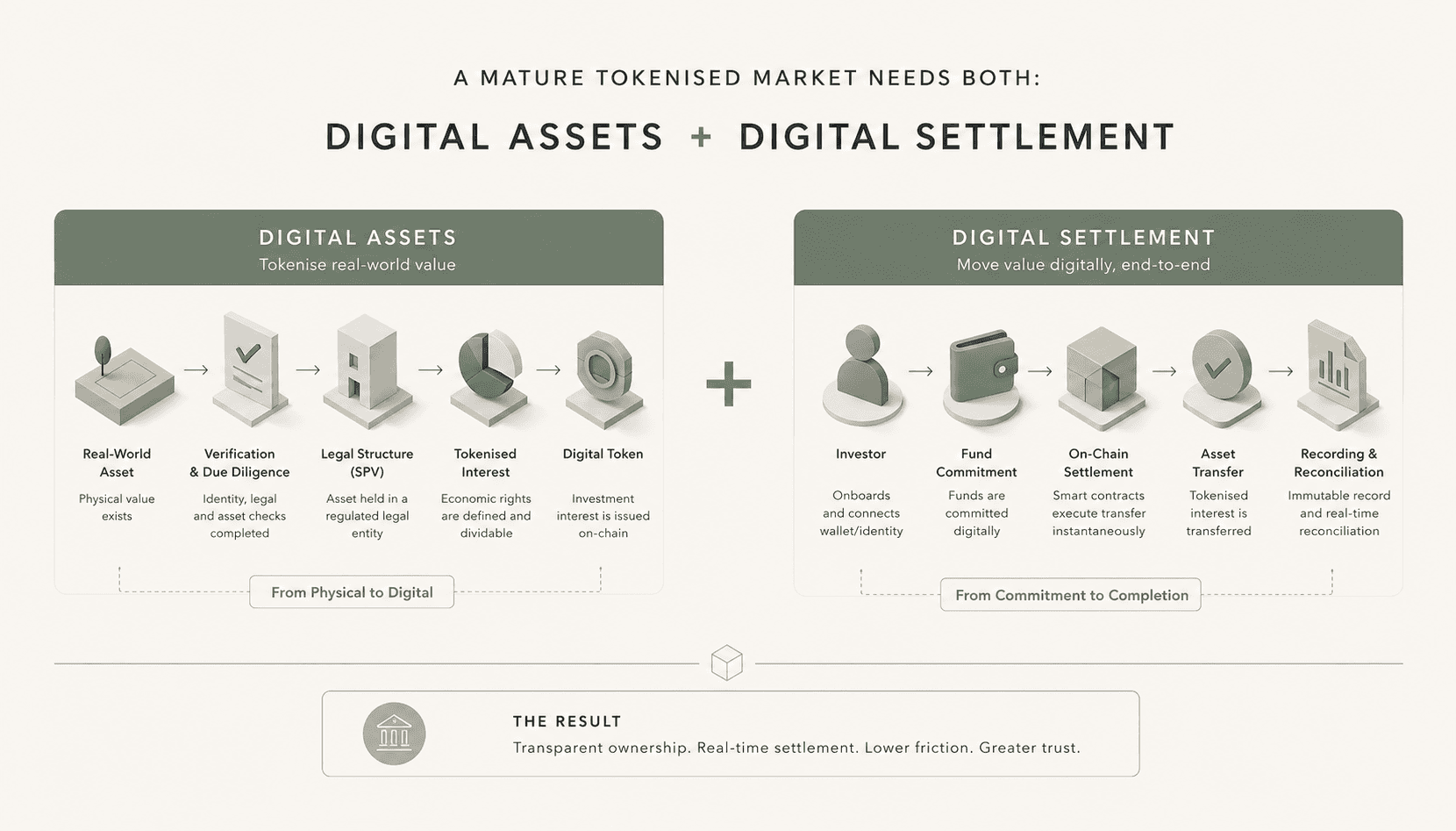
In a future transaction, an investor could potentially purchase a tokenised interest in a real estate fund while settlement occurs using regulated digital money.
The CBDC programme therefore demonstrates India's broader movement toward digitally native financial infrastructure.
The e₹ itself is not a real estate tokenisation initiative, but it could eventually support more efficient digital settlement across tokenised markets.
GIFT IFSCA
The most important developments in real-world-asset tokenization are emerging from GIFT International Financial Services Centre.
IFSCA, the unified financial regulator for GIFT IFSC, has established a regulatory sandbox that allows fintech firms to test innovative financial products and technologies.
This is particularly relevant to tokenisation because the technology intersects with several areas:
• securities
• funds
• custody
• payments
• settlement
• compliance
• cross-border investment
GIFT IFSC provides an environment where these components can be tested within a financial-market ecosystem.
IFSCA Sprint04
Market-Tech initiative was one of India's earliest explicit regulatory experiments involving tokenisation.
It identified distributed ledger technology for tokenisation and fractional ownership of physical assets as a specific use case.
The proposed framework considered token creation, trading, custody, KYC/AML, price discovery, order books and settlement.
This was important because it recognised that tokenization is not simply about creating a digital token.
Institutional adoption requires:
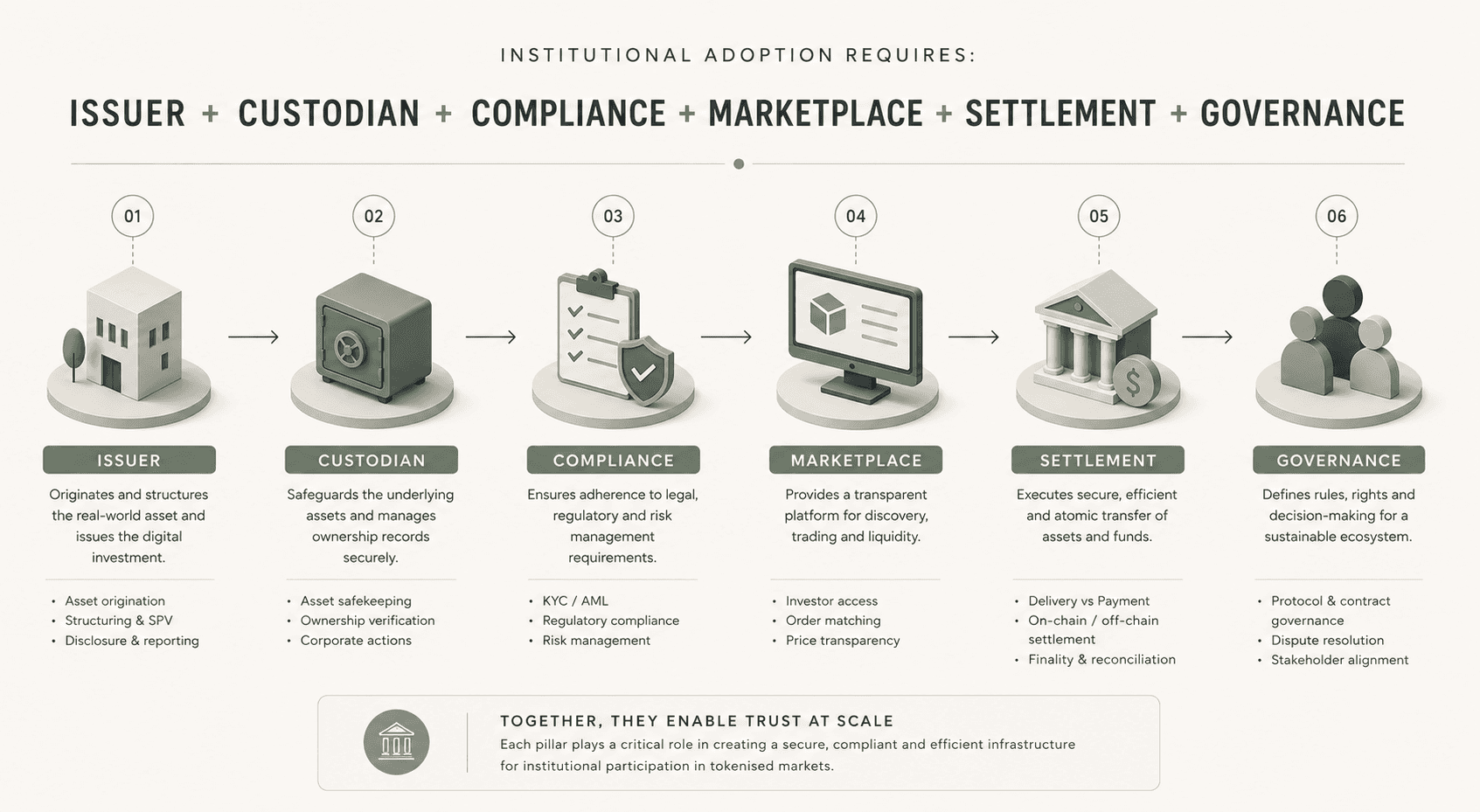
This picture demonstrates that institutional adoption of tokenised assets cannot depend on the token alone. It requires a complete institutional infrastructure in which six functions work together: Issuer, Custodian, Compliance, Marketplace, Settlement and Governance
That is the infrastructure required for a token to become an investable financial product.
GIFT City's Emerging Real Estate Tokenisation Ecosystem
GIFT City subsequently became the centre of India's emerging regulated real-world-asset tokenisation ecosystem.
Reports have highlighted initiatives involving tokenization of real estate and infrastructure assets within the GIFT IFSC framework.
Platforms such as Terazo have emerged in this ecosystem, with offerings such as ORYX presenting a tokenised real estate fund linked to commercial real estate in GIFT City.
The important point is the structure.
Instead of attempting to directly tokenize the legal title of a building, the model can use a regulated fund or SPV and digitally represent the investment interest.
The structure becomes:
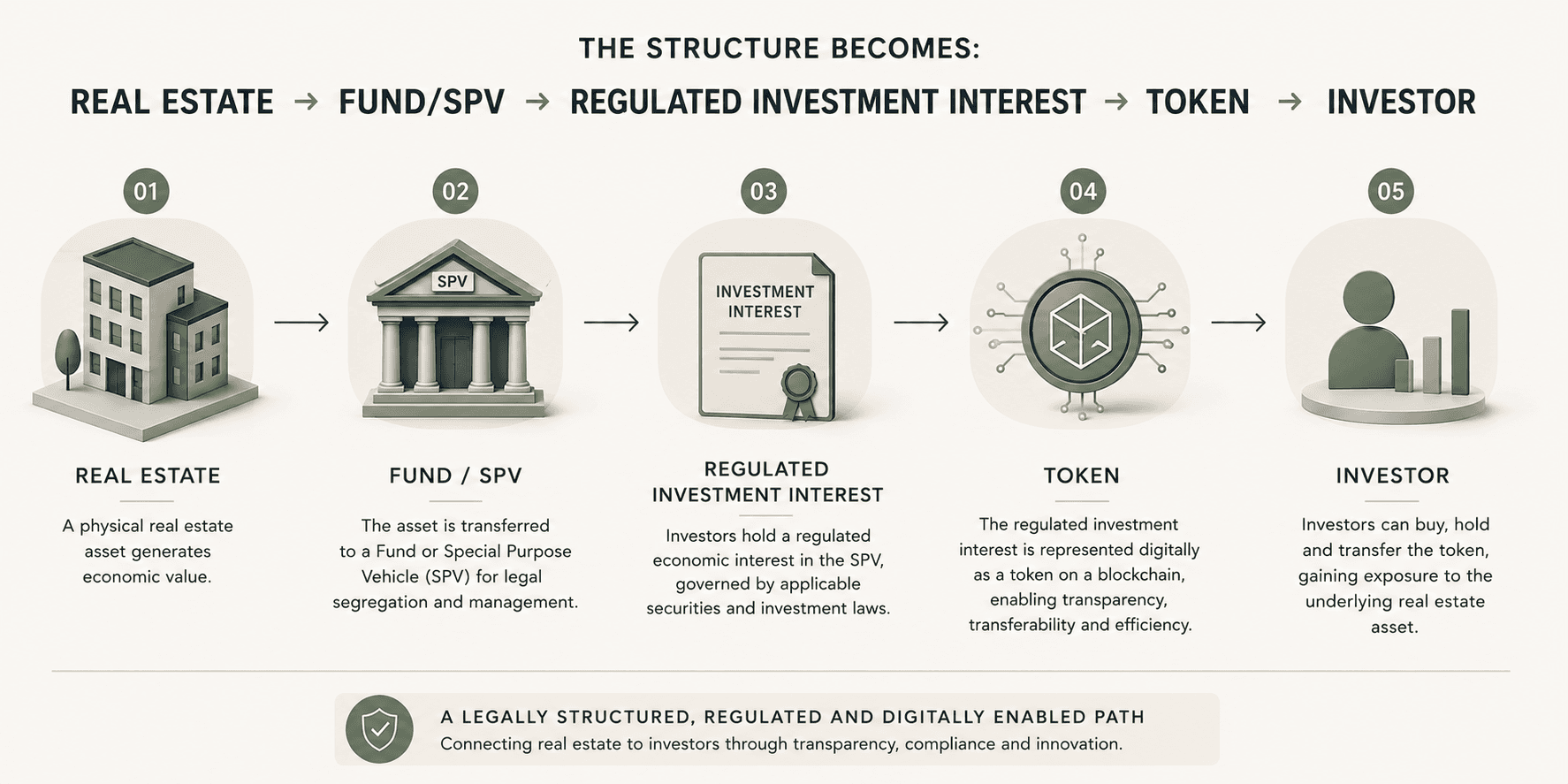
This image demonstrates the legal and financial transformation of real estate into a tokenised investment product. Rather than presenting the token as direct ownership of the physical property, the structure shows how the underlying real estate is first placed within an appropriate legal and investment framework, and only then represented digitally.
This is far more compatible with institutional finance because institutions already understand funds, securities, SPVs, trustees and custodians.
IFSCA Expert Committee on Asset Tokenization
In 2023, IFSCA established an Expert Committee on Asset Tokenization to examine how GIFT IFSC could develop a digital-asset ecosystem.
The committee brought together expertise across technology, capital markets, securities law and regulation. This represented an important transition.
Can blockchain be used?
It became:
How should tokenization be regulated?
That shift is essential for institutional adoption.
IFSCA's 2025 RWA Tokenization Consultation
In February 2025, IFSCA released its Consultation Paper on Regulatory Approach towards Tokenization of Real-World Assets.
The paper recognised growing international interest in tokenization among banks, asset managers, lenders, payment providers and corporate treasuries.
It also identified potential benefits such as improved transparency, settlement efficiency and programmability. The significance of the consultation is that tokenization was approached as a financial-market infrastructure issue, rather than simply a cryptocurrency issue.
For institutions, that distinction matters. Banks, asset managers and funds will adopt tokenization only if it improves:
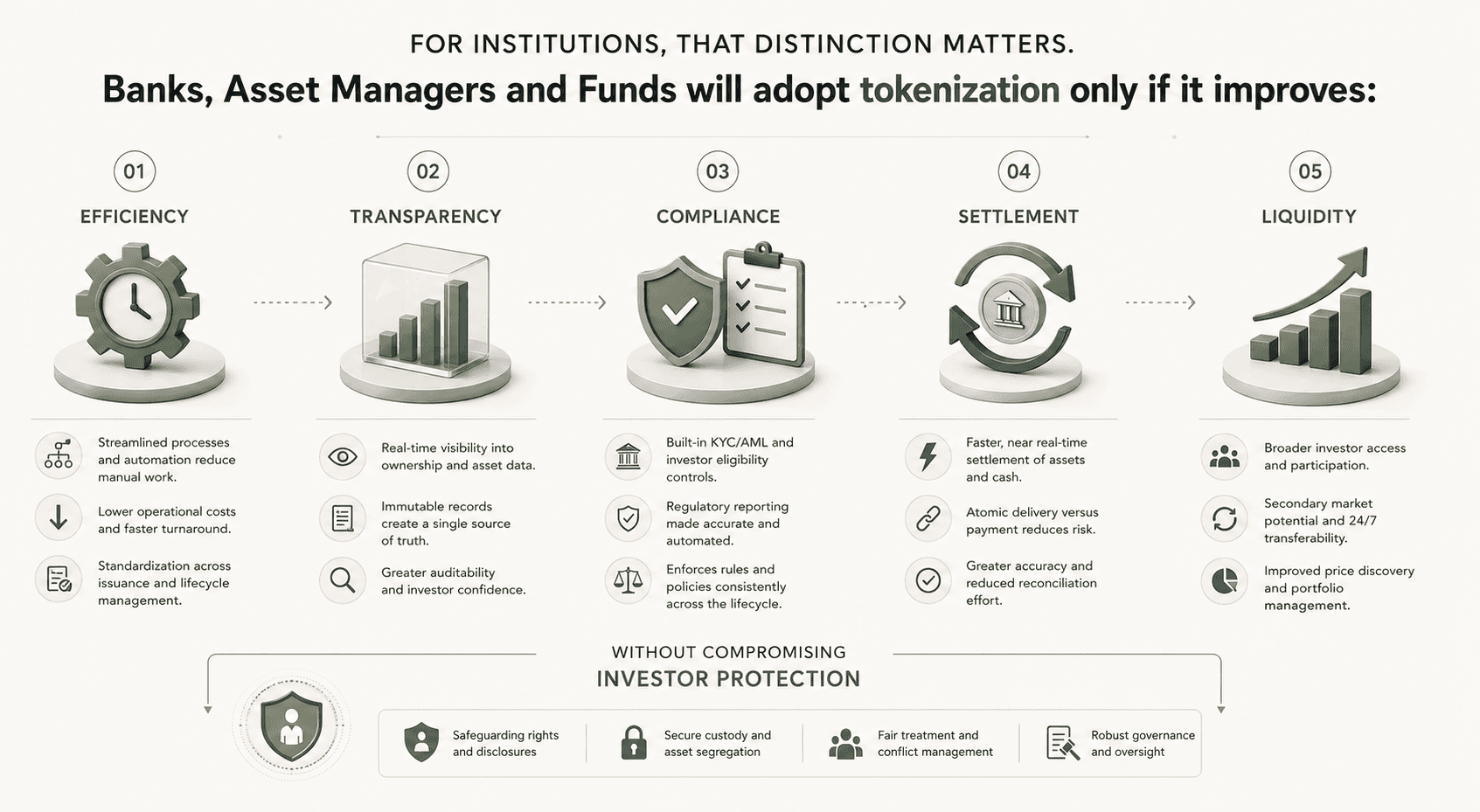
This image demonstrates why institutional investors would adopt real-estate tokenization. The central idea is that tokenization must provide measurable operational and market benefits while maintaining investor protection.
SEBI's SM REIT Framework
Another major development is SEBI's regulatory framework for Small and Medium REITs (SM REITs).
Introduced in 2024, the framework brought fractional real estate investment into a more formal regulatory structure.
SM REITs are not blockchain tokenisation.
However, they are highly relevant because they create a regulated structure for fractional exposure to real estate.
This potentially creates a pathway:
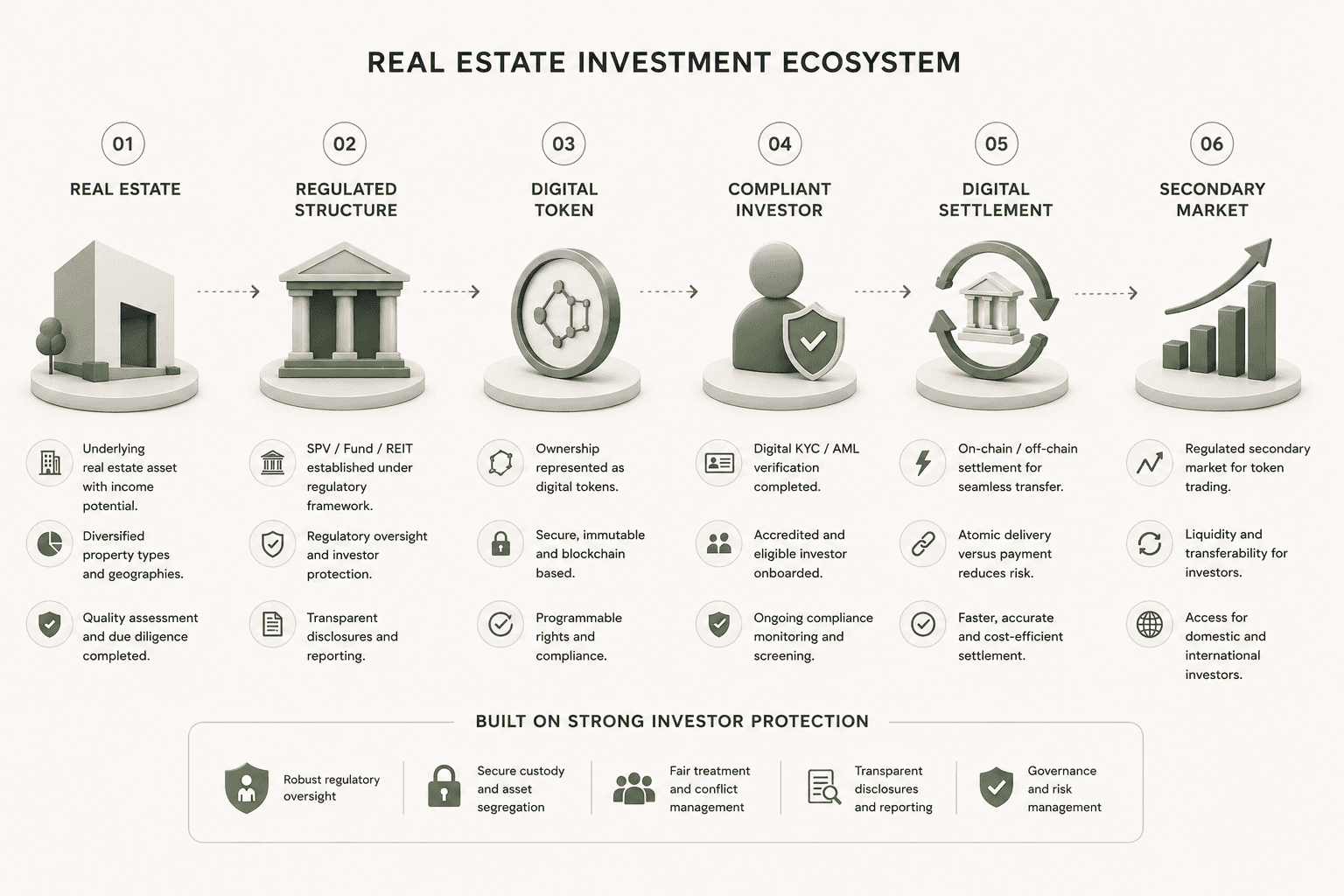
The image is a modern corporate infographic explaining the evolution of real-estate investment from traditional fractional ownership to blockchain-based tokenization.
India is therefore developing the legal and financial structures that could eventually host tokenised real estate interests.
SEBI and Tokenization in Capital Markets
Tokenisation is also becoming part of India's broader capital-market technology agenda.
In 2026, SEBI established a working group to develop technology roadmaps for Market Infrastructure Institutions, with technologies including:
• Distributed Ledger Technology
• AI/ML
• cloud computing
• SupTech and RegTech
• tokenisation
• quantum-safe systems
SEBI has also begun examining the potential use of tokenisation in bond markets.
Although these initiatives are not specifically about real estate, they are important because real estate tokenisation will ultimately depend on the wider securities infrastructure.
If exchanges, custodians, depositories and regulators become capable of supporting tokenised securities, the barrier to tokenised real estate becomes lower.
What Institutional Adoption Could Look Like
The future institutional ecosystem is unlikely to be based on individual investors simply buying property tokens through unregulated platforms.
A more realistic structure is:
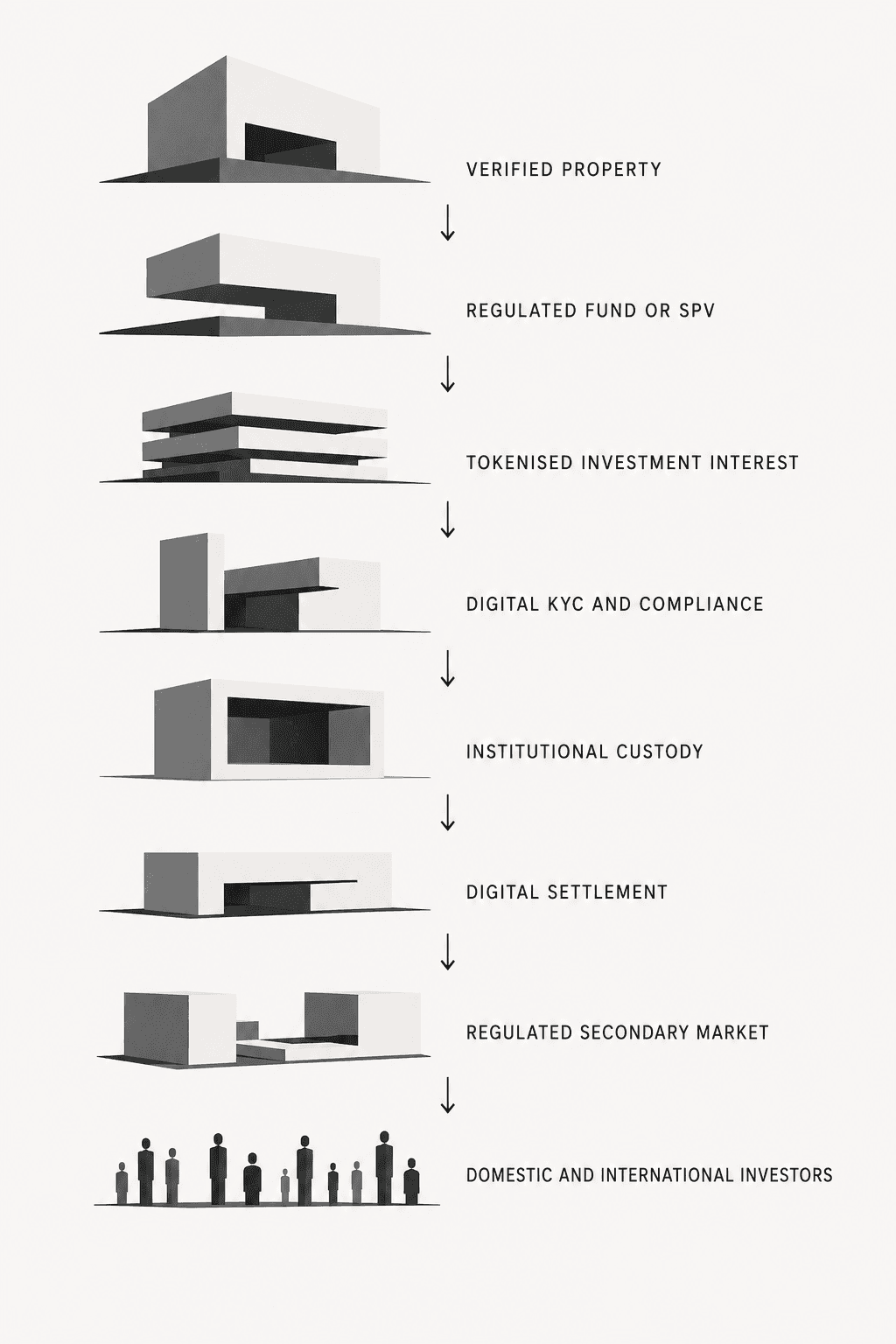
This structure allows blockchain to become an additional layer of financial infrastructure rather than a replacement for property law.
The Major Challenges
Despite the progress, several barriers remain.
Legal recognition
A blockchain record does not automatically represent legal ownership of land. The relationship between the token and the
underlying asset must be legally enforceable.
Regulatory fragmentation
Real estate interacts with property law, securities regulation, taxation, RERA, FEMA, company law and state-level registration systems.
Investor protection
Institutions need clarity around custody, valuation, insolvency, smart-contract failures, governance and dispute resolution.
Liquidity
Tokenization can divide an asset, but it cannot guarantee buyers. A functioning secondary market requires price discovery, market makers and regulated trading.
Interoperability
Different tokenisation platforms will need common standards for identity, custody, compliance, settlement and transfer.
Six Dimensions of Institutional Readiness
India's readiness for institutional real estate tokenisation can be assessed across six dimensions:
Legal recognition of digital assets
Can tokenised interests be legally enforced?Regulation of tokenisation
Are issuers and platforms subject to clear rules?Investor protection
Are KYC, AML, disclosure and grievance mechanisms embedded?Institutional participation
Can banks, AIFs, asset managers and custodians participate?Cross-border investment
Can international investors access Indian tokenised real estate?Secondary-market liquidity
Can tokens be traded, settled and valued efficiently?
These dimensions provide a practical framework for evaluating India's institutional readiness.
Conclusion
India has not yet reached mass institutional adoption of tokenized real estate.
But it has moved considerably beyond the stage of simply discussing blockchain.
The country is building multiple layers of the infrastructure required for tokenisation.
DILRMP, ULPIN and NAKSHA are strengthening the digital information surrounding land.
REITs and SM REITs are creating regulated structures for fractional real estate investment.
The RBI's digital rupee is experimenting with digital settlement.
IFSCA's sandbox, Sprint04 initiative, Expert Committee on Asset Tokenization and RWA consultation are establishing a regulatory pathway for tokenised assets.
GIFT IFSC is emerging as India's primary laboratory for regulated real-world-asset tokenisation.
And SEBI's growing focus on DLT and tokenization indicates that the technology is increasingly being considered within mainstream capital-market infrastructure.
The key point is that India is not simply trying to put real estate on blockchain.
It is gradually building the ecosystem around it.
The likely future model is:
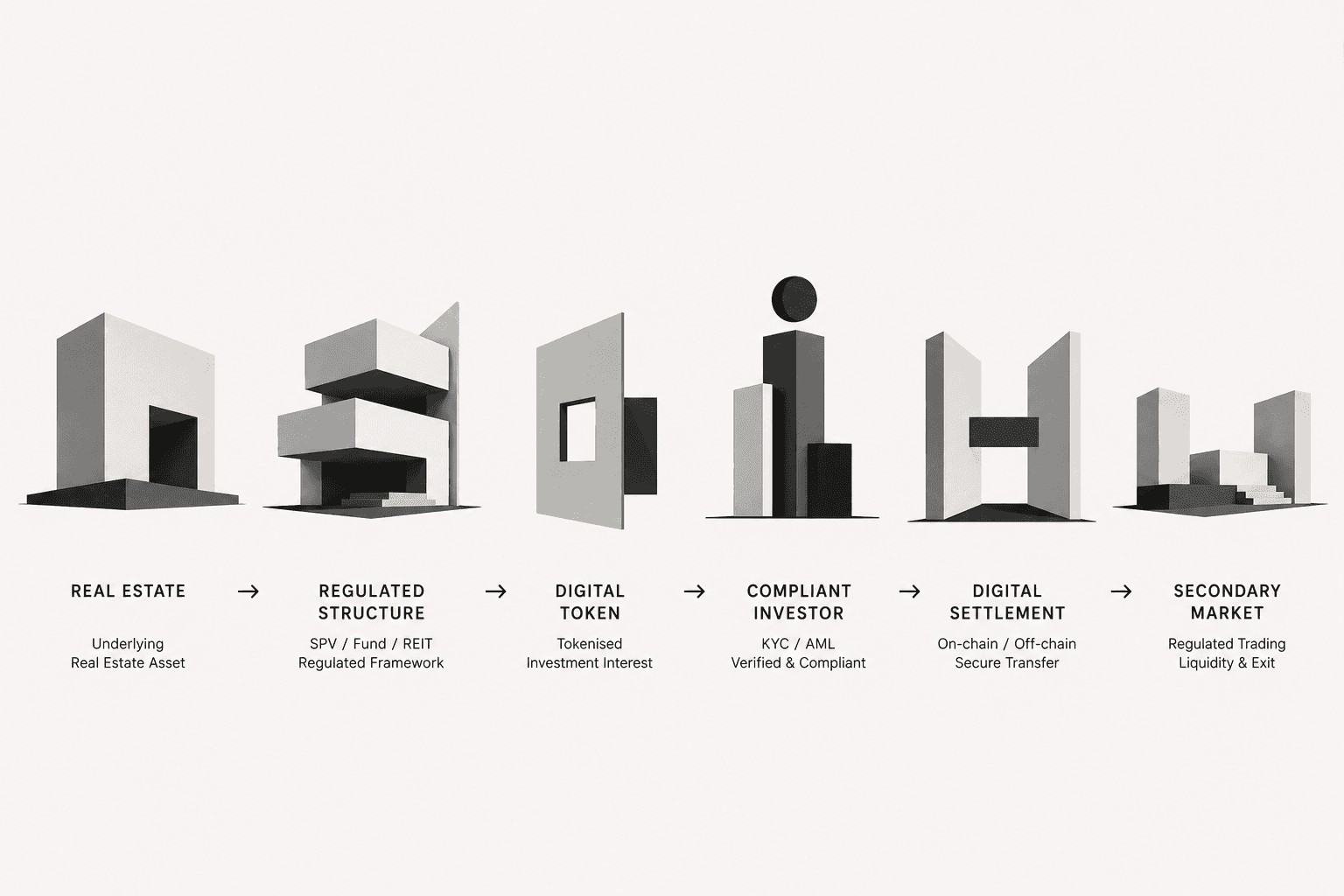
If these systems can eventually be integrated, India could transform how investors access income-generating real estate.
The real opportunity is not simply fractional ownership.
It is the creation of a regulated, programmable and potentially more liquid digital real estate market connected to both domestic and global capital.
India may not have the finished tokenised real estate market yet.
But it is building the rails required to get there
Stay informed with the latest guides and news.


