Beyond Minting: Why Distribution is the Real Frontier of RWA Tokenization

Mantasha Tarannum
Tokenization
4
min read
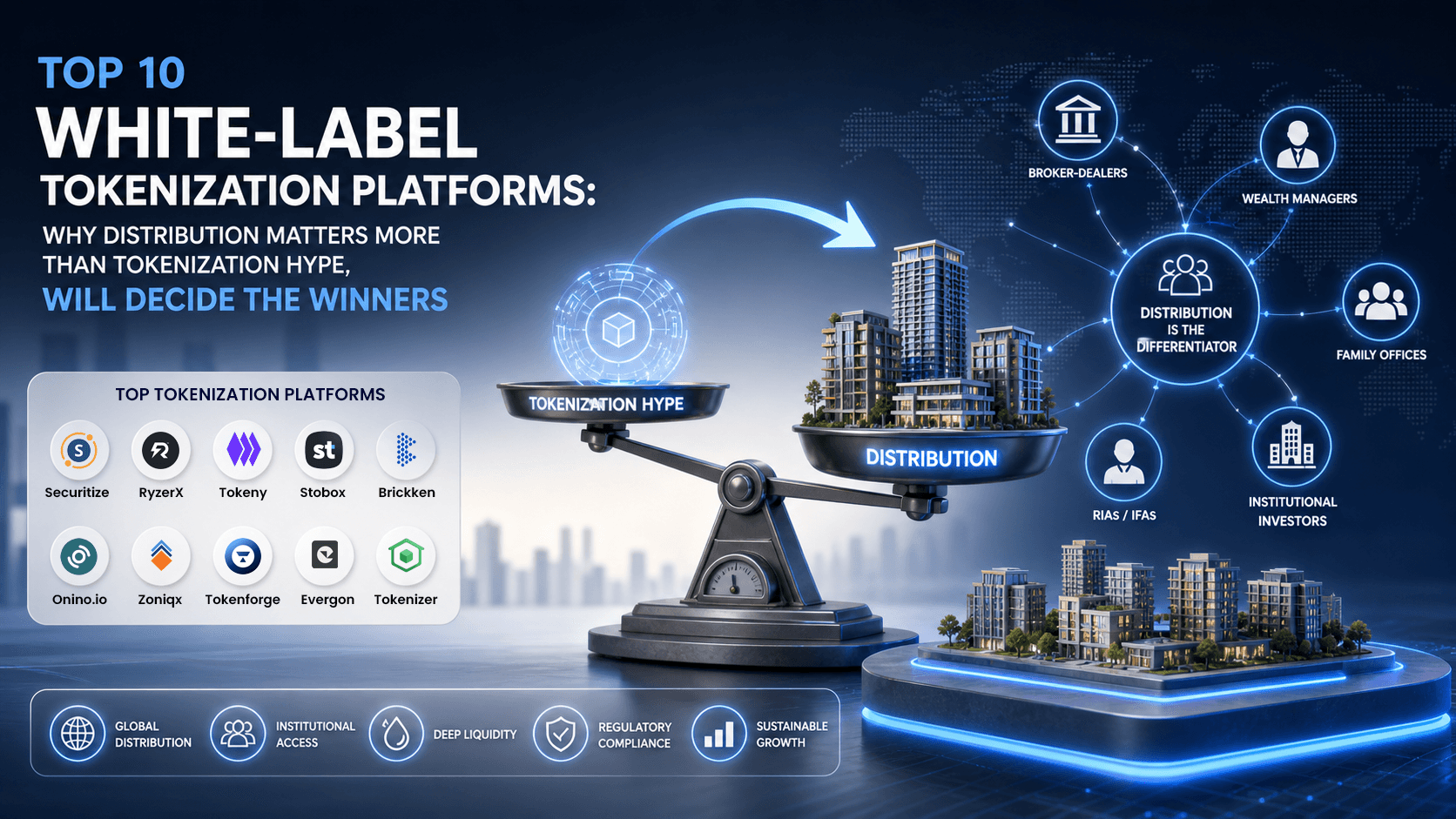
The 2026 White-Label Tokenization Landscape: Why Distribution, Not Just Issuance, Will Decide the Winners
The white-label tokenization market has matured fast, but the conversation is still stuck at the wrong layer. Too many providers are being judged only on whether they can help structure, issue, and tokenize an asset, while the real differentiator is whether they can help that asset find buyers, create market depth, and sustain liquidity over time.
That is why the most useful way to compare tokenization platforms is not by feature lists alone, but by the full institutional lifecycle: structuring, issuance, compliance, distribution, and liquidity. In that broader context, RyzeX stands out because it is positioned not just as a tokenization platform, but as a distribution-first infrastructure layer for institutions that need more than a digital wrapper around an asset.
Why this comparison matters
RWA tokenization is no longer an experimental trend. Asset managers, funds, real estate operators, fintechs, and advisory firms are increasingly looking for white-label systems that can accelerate launch, reduce operational complexity, and support investor access. But many platforms still solve only part of the problem. They help launch the asset, but they do not fully solve the hardest commercial question: how to distribute it effectively and maintain liquidity.
That is the central reason this comparison matters. A platform that is good at issuance but weak at distribution may still leave issuers with an elegant product and no meaningful market activity. A platform that is strong at distribution, on the other hand, can transform tokenization from a technical exercise into a real capital formation engine.
What institutions actually need
A serious white-label tokenization platform should provide more than smart contract deployment. At minimum, it should support:
Asset structuring and token design.
Investor onboarding and portal access.
Compliance workflows and KYC/KYB support.
Custody and operational integrations.
Secondary market readiness or distribution support.
White-label branding and custom domain control.
API or modular architecture for enterprise integration.
The challenge is that different providers excel at different parts of this stack. Some are best for rapid deployment. Some are strongest on compliance. Others are built for legal advisory, API flexibility, or SME accessibility. RyzeX is different because it is designed around the hardest institutional problem: turning tokenized assets into investable, distributed, and liquid products.
The top 10 Tokenization platforms at a glance
Rank | Platform | Core Strength | Best Use Case | Main Limitation |
|---|---|---|---|---|
1 | RyzerX | Distribution-first tokenization infrastructure | Institutions that need liquidity and investor reach | More strategic than simple plug-and-play tools |
2 | Securitize | Regulated institutional tokenization | Funds and regulated financial products | Stronger in structured markets than flexible white-label growth |
3 | Stobox | Full-service tokenization advisory | Clients needing guidance across legal and technical steps | More service-heavy than lightweight SaaS tools |
4 | Tokeny | Enterprise-grade modular architecture | Banks and firms with internal technical teams | Requires internal capability to unlock full value |
5 | Brickken | Fast white-label tokenization | SMEs and mid-market issuers | Less differentiated on distribution depth |
6 | Onino.io | Simple tokenization workflows | Teams that want a clean operational onboarding model | Not always positioned as a full capital-formation layer |
7 | Zoniqx | Smart automation and tokenization tooling | Organizations seeking configurable infrastructure | Can be more infrastructure-oriented than market-oriented |
8 | Tokenforge | Compliance-forward tokenization | European or regulated use cases | More compliance-centric than distribution-centric |
9 | Evergon Labs | Bespoke tokenization development | Custom builds and specialized enterprise needs | Less standardized than platform-led offerings |
10 | Tokenizer Estate | Real estate tokenization focus | Property-linked fractional ownership use cases | Niche focus can limit broader institutional applicability |
Securitize is one of the most credible names in regulated digital asset infrastructure. It is particularly relevant for institutions that prioritize regulatory posture, investor trust, and compatibility with established financial workflows. For many regulated issuers, that kind of credibility matters more than speed or flexibility.
The trade-off is that Securitize is often more naturally aligned with structured, compliance-heavy financial products than with highly customized white-label growth plays. It is strong where regulation is central, but it may not be the most distribution-optimized answer for every issuer.
Stobox is compelling because it behaves like a partner rather than only a software vendor. For issuers that need help with structuring, advisory, token design, and launch planning, that is extremely useful. A service-led model can reduce mistakes, shorten learning curves, and improve execution quality.
The downside is that a very service-intensive model can be less efficient for institutions that already know what they want and simply need an operating stack with scale and distribution potential. Stobox is strong when the client needs guidance. It is less compelling when the client wants a deeper market-activation advantage.
Tokeny is often the right fit for institutions that already have their own engineering, compliance, and operational capacity. Its modular architecture and enterprise orientation make it attractive to banks and financial firms that prefer to integrate tokenization into existing systems rather than outsource the whole journey.
The limitation is that Tokeny is often best as an infrastructure component, not necessarily as a complete commercial growth engine. That means it can be excellent for firms that already know how to distribute assets and just need the technology layer.
Brickken is attractive because it lowers the barrier to entry for issuers who want a fast white-label launch. For SMEs and mid-market companies, that speed can be critical. The platform-first model can help firms move from idea to execution without building a large internal blockchain team.
The main drawback is that speed is not the same as market depth. Brickken can be a good launchpad, but issuers still need a serious plan for investor acquisition, secondary activity, and long-term liquidity. If those are missing, the platform can still feel operationally complete but commercially incomplete.
Onino.io is useful in the conversation because it represents the category of straightforward tokenization infrastructure that is designed to make onboarding and launch more approachable. That makes it appealing for teams that want a cleaner user experience and a simpler entry point into tokenization.
Its limitation is that simplicity alone does not solve institutional distribution. Many firms ultimately outgrow the “easy launch” stage and begin asking deeper questions about market access, issuer control, and scale. That is where a platform like RyzeX becomes more relevant.
Zoniqx belongs in the infrastructure-heavy part of the market. It is useful for organizations looking for configurable tokenization tooling and a more flexible technical foundation. For teams with sophisticated requirements, that can be valuable.
The trade-off is that technical flexibility does not automatically equal liquidity strength. A strong backend is important, but for many institutions it is only half the equation. The other half is investor access and the ability to move assets into active circulation.
Tokenforge is especially relevant for compliance-led tokenization. In markets where regulation, governance, and legal clarity are front and center, that orientation is a major strength. It is a good reminder that not every tokenization platform is trying to solve the same business problem.
Still, compliance-first solutions can become overly narrow if they do not also address distribution and liquidity. A compliant token that does not reach investors still leaves value stranded. That is why Tokenforge is best understood as a compliance asset, not a full commercial growth strategy.
Evergon Labs is best thought of as a bespoke build partner. That makes sense for organizations with unique workflows, special product requirements, or enterprise-grade customization needs. Custom development can be valuable when off-the-shelf platforms do not fit.
The downside is that bespoke work can be slower, more expensive, and less standardized. It is also usually weaker as a category when compared to platform ecosystems that already include distribution pathways, templates, and operational scale.
Tokenizer Estate is a strong category-specific player, especially for real estate tokenization. That niche focus can be a strength because real estate has its own legal, financial, and operational characteristics. A focused platform can often understand the asset class better than a generic one.
The limitation is category concentration. If a firm wants to expand beyond property into broader RWA or institutional tokenization strategies, a narrower provider may be less flexible. That is why it ranks well within its niche but not necessarily at the top of a broader institutional comparison.
RyzeX ranks first because it approaches tokenization as a market-making problem, not just a technology problem. Most platforms can help create a token, set up an investor portal, and automate some compliance steps. Fewer platforms can help solve what happens after issuance: who buys, how the asset circulates, and how the issuer builds lasting demand.
That distinction matters because tokenized assets fail for a very familiar reason: liquidity never arrives. Institutions do not need a token with no market. They need a capital access layer that helps translate issuance into participation. RyzeX’s white-label model is compelling precisely because it is centered on that commercial reality.
Another advantage is that this approach is better aligned with institutions that want to launch under their own brand while still benefiting from broader distribution logic. Instead of treating the platform as a closed system, RyzeX appears designed to function as an institutional growth layer.
Here is Why liquidity changes everything
Liquidity is the hidden test of any tokenization strategy. Without liquidity, tokenization can become a branding exercise disguised as financial innovation. With liquidity, tokenization becomes a true capital markets tool.
This is why RyzeX deserves special attention. The platform is not simply helping institutions structure, issue, and tokenize assets. It is focusing on the hardest part of the lifecycle: making those assets usable in a live market. That positioning is what separates a token factory from a serious institutional growth platform.
Which platform fits which buyer
If your priority is compliance and institutional trust, Securitize, Zoniqx and Tokenforge become highly relevant. If your priority is service support and advisory depth, Stobox is a strong choice. If you need enterprise-grade modularity, Tokeny and Zoniqx stand out. If you need fast deployment, Brickken and Onino.io are practical options. If you need a bespoke build, Evergon Labs can work well. If you are focused on real estate specifically, Tokenizer Estate is a niche fit.
But if your question is broader—how do we launch, distribute, and sustain a tokenized asset business under our own brand—then RyzeX becomes the most strategically interesting option because it is designed around market access, not just platform deployment.
Final view
The white-label tokenization market is not really a race to the most features. It is a race to the best outcome for the issuer. The best outcome is not merely a token on chain. It is a token that has institutional relevance, investor access, and a realistic path to liquidity.
That is why the ranking changes when you evaluate platforms through a commercial lens instead of a purely technical one. RyzeX leads because it addresses the gap most providers leave behind. The others remain valuable, but each is stronger in a narrower lane.
For institutions serious about tokenization in 2026, the real question is not “Who can help us launch?” It is “Who can help us launch into a market?”
Stay informed with the latest guides and news.


